



Book Chapter
Catechizing the Whole World, Pedro Arrupe (1977)
Originally in: Pedro Arrupe, S.J. ,”Catechizing the Whole World,” in Other Apostolates Today: Selected Letters and Addresses—III, ed. Jerome Aixala. St. Louis: The Institute of Jesuit Sources, 1981, 167–70.
DOI: 10.51238/qQk9UjH
Arrupe, Pedro, S.J. “Catechizing the Whole World, Pedro Arrupe (1977).” In Essential Documents: Selected Sources for Jesuit History, edited by Institute for Advanced Jesuit Studies. Institute of Jesuit Sources, July 15, 2026. https://doi.org/10.51238/qQk9UjH
Info and Contents
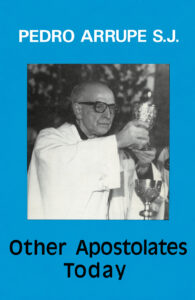
Other Apostolates Today
Selected Letters and Addresses—III
 Open Access
LCCN: 81080741
ISBN10 (hcv): 0-912422815
ISBN10 (pbk): 0-912422807
ISBN (hcv): 978-0-912422-44-2
ISBN (pbk): 978-0-912422-80-0
Copyright: 1981
Publisher: Institute of Jesuit Sources
In the text below, from his second of two addresses to the Synod of Bishops on Catechesis in October 1977, Superior General Pedro Arrupe speaks on the “enormous field … a large segment of humanity” that is open to catechesis by the Catholic Church when compared to the “very small remnant” of those who actually attend Mass. Arrupe points to those people who “either totally, or to a great degree, cut off from the Church and her catechetical activity.” He claims that catechists would such individuals—“professionals (doctors, engineers, etc.), artists, politicians, young athletes, mountain climbers, hippies, workers in their unions or in their factories or in their neighborhoods or in their co-operatives”— to be “well disposed for instruction if anyone would seek them out where they live and would speak to them in a language they understand.”
After listening to the reports from the Circuli Minores, I experienced a deep feeling of complacency in the face of this abundant wealth of insights and proposals. Here was a clear witness to the action of the Spirit in God’s Church.
And yet, later on—perhaps because of an Ignatian tendency to discern the spirits—I discovered that this reaction was noticeably different from that produced in me by the Holy Father’s homily in the Mass opening the Synod in the Sistine Chapel, in which he spoke to us of the “range and breadth of our Ministry.” He defined our ministry as “universal and catholic, even, with the native force of the Greek word, cosmic.”
In this way, the Holy Father opened up for us wide, “cosmic” horizons. And we were breathing the air of “go into the whole world and preach the Gospel to every creature,” a text which he himself cited.
Instead of this, some of the concerns of the Synod seem to me to reflect a worried, narrowing or restrictive tendency, as if that wide open, limitless horizon were shrinking and narrowing because of a preponderant absorption in a select group of people which the Church is de facto reaching today—a group very small in comparison with the world-wide Catholic population.
Perhaps the understandable concern for planning a Catechesis in the strict sense of the term, complete and orthodox, could give the impression of fostering a policy of elitism, giving rise to a process of inbreeding.
To achieve a balance between this position, more “ad intra,” and another complementary position “ad extra,” centrifugal, extra-mural, we should put the questions: Where are the catechumens of today? Who are they? and with no less urgency and concern: Where are those who could—or should—be catechumens? Who are they?
Locus of Catechesis
The loci of catechesis have been listed: family, parish, catechetical groups, the school.
Family
How many families are today in reality a valid vehicle of catechesis? Has not the de-Christianization of the family become axiomatic in wide sectors of the population? And, even if they were able to catechize their small children, are parents with their older mentality the right ones to reach their children of 15 years and older? Where are the large majority of teenagers going to receive their catechism?
Parish
How many does the parish in fact reach? Amid the diversity of rural, urban and suburban parishes, in so-called Catholic countries as well as on the mission in, every kind of culture, according to statistical data in many countries it is only 10% of the faithful who have the opportunity—when they come to Sunday Mass—to receive a brief instruction by way of the Homily. What happens to the other 90%?
Catholic School
In many countries, the school reaches less than 15% of the Catholic school-age population. What will happen to the 85% who are educated in other schools?
Catechetical Groups
What percentage of genuine practicing Catholics are organized in this systematic catechesis for seven years? 10%? Still less? I do not intend these questions as merely rhetorical—still less am I suggesting a critical or pessimistic position. Rather, I urge realistic reflection so that we can work with hard data.
Catechumens, Catechists, Catechism
For these reasons, I would like to draw your attention to other fields of activity which offer great possibilities, in which, if we go about it correctly, we will be able to find effective co-workers who can be trained as agents of a catechesis adapted to their cultural milieu.
Who are the people we have to reach in catechesis?
They are either totally, or to a great degree, cut off from the Church and her catechetical activity. They would be well disposed for instruction if anyone would seek them out where they live and would speak to them in a language they understand. Who are they? They are the professionals (doctors, engineers, etc.), artists, politicians, young athletes, mountain climbers, hippies, workers in their unions or in their factories or in their neighborhoods or in their co-operatives. They are all the natural groupings in which people are drawn together for various reasons, people who have the same problems, personal or professional.
Where are they?
Every one in his own milieu, in his own group. That is where we have to go to find them and carry on our catechesis. Sharing in the same milieu, and the same group, participating in their professional meetings or recreational activities, instructing on their ground, catechizing on a trip to the mountains, surrounded by the beauties of nature, or getting our word in between the light music and the Beatles’ records.
Sometimes the undertaking of getting people to come to church can only be accomplished after a preliminary stage in which the church has to come to them. For their part, they have not come yet, and they are not going to come. Perhaps the thought of coming has occurred to them, but given the conditioning of their cultural situation, they are not able to come. And yet, many would like to come and they would listen to us if we could find the way to talk to them where they are, in a way they understand.
Who will be the catechists?
Of necessity, it will be members of the groups we are trying to reach, a true multiplication effect of ecclesial action. Once such people are formed, they will carry on a specialized catechesis, with new forms, channeling their experience and their life of faith through stream-beds as yet unknown. They too are the ones to answer the question: How catechize?
What will be their catechism?
It will not be the same for all. They will need one that, keeping intact the deposit of faith, will know how to present it in a form, with a tone, adapted to the mentality and the needs and milieu of the group. The catechism of artists will be very different from that of workmen, of judges or drug addicts.
It is an enormous field. Such a large segment of humanity, in comparison with which those who find their way to our churches show up as a very small remnant. In my opinion, the Synod should be attentive to this problem and avoid an almost exclusive preoccupation with a perfectionist catechesis of traditional methods—reaching numbers necessarily small—relegating to a secondary position a catechesis (can we keep on calling it that?) of penetration in the multitude (I avoid the word “mass”). A multitude powerful and dynamic in other respects, which has proved impervious to the methods we have used up till now. And they are souls who are looking for a special effort from the Church.
I close with a reference to the catechesis of the first days of the Church. I think of Paul who did not limit his catechesis to the synagogues but went out to slaves and masters, to followers of the Old Law and, with preference, to Gentiles. He wrote to this Church of Rome, which he had dreamed of visiting, “How shall they believe in Him of whom they have not heard? How shall they hear unless someone preach to them? And how shall they preach if they are not sent?” God grant that we will be able to respond with Paul: “Your Word has gone forth to the ends of the earth.”
Other Apostolates Today
Selected Letters and Addresses—III
Open Access
LCCN: 81080741
ISBN10 (hcv): 0-912422815
ISBN10 (pbk): 0-912422807
ISBN (hcv): 978-0-912422-44-2
ISBN (pbk): 978-0-912422-80-0
Copyright: 1981
Publisher: Institute of Jesuit Sources
© Institute of Jesuit Sources, Institute for Advanced Jesuit Studies, All Rights Reserved