



 Open Access

Prologue
October 2018. I was sitting in the president’s office at St. Xavier High School in Cincinnati, Ohio, eagerly awaiting a meeting with Mr. Tim Reilly ’76, our newly inaugurated president. Resting in my lap was a box containing one of the school’s most precious historical records: a fragile student register from the 1840s. Also on hand was a single sheet of paper bearing the words “St. Xavier High School Archivist” typed in bold at the top and underlined for good measure. Below that was a list of responsibilities for a position that, at least officially, did not yet exist.
Despite my best efforts to quiet my thoughts, my mind raced. What would Mr. Reilly think of me? More importantly, what would he think of my proposal? Sitting there, I could not help but think how improbable the moment felt. With a pounding heart and sweaty palms, I anxiously awaited Mr. Reilly’s arrival. He walked in a few minutes later, and I rose to shake his hand.
Beginnings
I was originally hired at St. X in March 2015 as a second-shift custodian. Prior to that, I lived in Seattle, having relocated in 2010 after graduating from Xavier University with a degree in history. I spent a couple of years working in coffee shops, yet I found myself aching for home, for the Queen City. After returning to Cincinnati, I continued to work as a barista, but I desperately longed for something that was more personally fulfilling, something that would allow me to put my love of history to use.
Looking for a change, I searched online and happened to see a job posting for an opening in the Facilities Department at St. Xavier High School. My years as a student at St. X are some of my most treasured, and the thought of returning as an employee was an exciting proposition. The facilities position was not what I ultimately hoped to do, but the job would be a foot in the door, so to speak, and it appeared to promise more opportunity than my job in the service industry.
After a standard interview, I was hired, and two weeks later I started working the 2:30 p.m.–11:00 p.m. shift.
Though still unsure of what my long-term plan was, I relished being back at the institution where I had spent my formative teenage years. For the first time in my life, I loved where I worked. It was satisfying to see the many ways in which the school had stayed the same in the nine years since I had last walked its halls: Friday night football and basketball games, AMDG, pep rallies, the Mass of the Holy Spirit, singing the Alma Mater, all basically as I recalled them. But not everything was familiar. Technology had completely changed the pedagogical landscape in new and exciting ways, and there were far more extracurricular opportunities available to students than ever before. In my mind, St. X seemed even better than I remembered. I was grateful to be back.
I quickly adapted to my new responsibilities: trash removal, vacuuming, dusting, window cleaning, floor scrubbing, and setting up rooms for meetings and events. I was given a “zone,” meaning I was responsible for cleaning everything within that area each day. My jurisdiction included the religion and campus ministry departments, the president’s office and conference room, as well as offices for marketing, admissions, and the yearbook.
As often happens, the days turned to months, and the months soon became years. I enjoyed my duties as much as anyone could, but I desired more. History had always been my passion, and I still hoped that I might somehow eventually find a way to make it part of my daily work.
So, for two years I waited for an opportunity to reveal itself. And then, suddenly, it did.
During the summer of 2017, I came across a small army of student workers relocating file cabinets and shelving from one part of the building to another. My curiosity was piqued, and I soon discovered what was kept in the cabinets and on the shelves: the school’s historical records. I remember being particularly intrigued by the collection of yearbooks, especially older ones from the 1920s and 1930s. I had never seen them before, and I was captivated by the images, prose, and portrayal of student life at St. X some 90 years earlier. A cursory examination of some of the other material revealed 19th century student registers, along with correspondence, meeting minutes, boxes of photographs, and other records documenting many aspects of the school’s history. With my historical senses tingling, I set out to learn more. First and foremost on my list was finding out who in the building worked with this material.
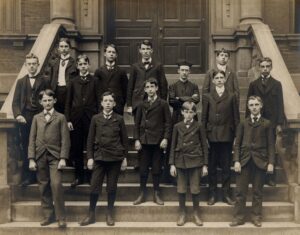
Figure 1. First Academic photograph, ca. 1897. Rev. Gilbert Garraghan, S.J., is pictured among the students. Garraghan would later author The Jesuits of the Middle United States. St. Xavier High School Archives.
After asking around, I soon found an answer: Karl Hauck. Karl was a longtime history teacher at St. X who, despite retiring from teaching in 1999, continued to come into the school two days a week for a few hours, mostly working as an auxiliary clerk. However, he also served as the school’s archivist. In this role, he collected items and information pertaining to the school’s history. But most importantly, he protected the institutional records of St. X and ensured this important history was not lost through the decades.
I arranged for a meeting with Karl to find out more. He informed me that his work as the school’s archivist was purely voluntary and that he did not have any kind of budget. Karl had managed to purchase a handful of archival boxes and folders through the years, but most of the historical material was largely untouched and minimally processed. To make matters worse, much of the material had become disorganized as a result of the recent summer move.
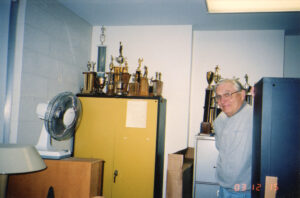
Figure 2. Photograph of Karl Hauck in the former archival storage area, 2015. St. Xavier High School Archives.
Over the course of the next few weeks, I was unable to stop thinking about the archival records and my conversation with Karl. I had attended St. Xavier as a student and worked at the school for more than two years, yet until that summer I had no idea the archives even existed. What had begun as simple curiosity gradually gave way to something deeper. The school was sitting on an absolute treasure trove of historical primary source material, yet few people even knew it existed. Furthermore, temperature and humidity fluctuations were taking their toll, and even basic preservation standards were not being met. Karl did the very best he could with the limited resources he had, but there is only so much one can do without the time, money, space, and support to do it.
Gradually, I became convinced that a paid archivist position at the school could and should exist. As Karl said, “The nearly 200-year history of this amazing place is too valuable to lose. St. Xavier is too important to not preserve its history and memories.”
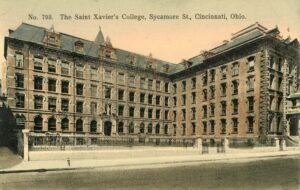
Figure 3. St. Xavier’s College postcard, ca. early 1900s. St. Xavier High School Archives.
Shortly thereafter, and with Karl’s blessing, I scheduled a meeting with Fr. Rick Millbourn, S.J., whom I had come to know during my time as a custodian. At the time, he moderated the yearbook and was often working in the yearbook office when I cleaned it each day. More importantly, he was both a Jesuit and an alumnus of St. Xavier. I trusted his judgment, and I wanted to know whether he thought a paid archivist position at the school was even within the realm of possibility. If he believed the idea had merit, then I knew it was worth pursuing.
As it turned out, Fr. Millbourn was very receptive to what I had to say. When I asked what my next steps should be, he encouraged me to meet with individuals in admissions, marketing, and other departments around the school to share the idea and gauge their interest.
Encouraged by our conversation, I drafted a single sheet of paper outlining theoretical responsibilities for a St. X archivist position: organize, preserve, and digitize existing archival material; contribute historical articles to St. Xavier Magazine; develop and maintain a St. Xavier Archives website; provide historical material for school functions such as open houses and class reunions; serve as a resource for the wider St. Xavier community; and help prepare for the school’s bicentennial celebrations in 2031.
With proposal in hand, I met individually with the directors of admissions, marketing, and advancement. Each was receptive to the idea and recognized the potential value of having such a position at the school. Our then-marketing director, in particular, embraced the proposal and graciously offered to champion it further up the chain of command.
However, in early December 2017 I received word that a shortfall in the school’s operating budget would prevent the establishment of an archives position; there just was not enough money to create an entirely new job. To say I was devastated would be an understatement. I knew the budget piece would be the hardest hurdle to surmount, but my optimism was high up to that point. For some time afterwards, I genuinely believed the idea had reached its end.
But there was one small sliver of hope on the horizon. A new president would soon be arriving, and with a new president would come a new budget and, perhaps, another opportunity. The marketing director counseled patience; we would try again the following school year.
And so, in early October 2018, I found myself sitting in the president’s office, the very office I cleaned every day, awaiting Mr. Reilly’s arrival. I was unsure of what to expect this time. Mr. Reilly was new to the position, and I did not yet know what his priorities would be. Additionally, I knew I was only one of many individuals bringing ideas and budget requests.
To help my proposal stand out, I brought along the oldest institutional document I could find: the 1840–69 St. Xavier College register. It dates from when the Jesuits took control of the school and contains handwritten entries for every student who had enrolled between 1840–69: date of entry, parent/guardian names, residence, age, and religion. The register was an extraordinary piece of institutional history, and I hoped it would somehow be impressive enough to justify the cost of an archivist position.
The meeting went well enough, but I left with a knot in my stomach. I knew I was asking for a lot, and I found it difficult to evaluate President Reilly’s reaction. Did I make a good impression? Was I persuasive? He was polite and sincere, but would budget concerns scuttle my initiative yet again? All I could do now was wait.
Soon, however, I received encouraging news: President Reilly was interested and agreed to a part-time archivist position starting the following school year. Until then, the marketing director would pay me on an hourly basis so that I could get things rolling.
I couldn’t believe it. I had finally been given the opportunity to prove that the idea could work. Of course, it was not the full-time position that I had hoped for, but it was something! It was a start. And if I could demonstrate the value of the archives, I was confident everything else would follow.
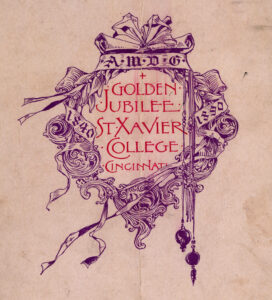
Figure 4. St. Xavier College Golden Jubilee program cover, 1890. St. Xavier High School Archives.
So, while still working full-time as a custodian, I devoted every spare moment I could to building the archives. First on my priority list was to create the foundational documents I would need: a collection policy, accession and deaccession forms, temporary custody receipts, separation forms, and a deed of gift for donations. Without these, there could be no functioning archives.
Next, I conducted inventories of school publications: yearbooks, newspapers, magazines, and athletic programs, carefully noting how many copies of each we had and which copies and editions we were missing. I had no boxes or folders for this material yet, but it was an important first step on the way to establishing physical and intellectual control of the records.
After that, I moved on to digitizing over 90 years’ worth of yearbooks. It was an extremely time-consuming task, but I quickly realized it was one of the best investments I could make. What had once required hours of paging through volumes of annuals could now be accomplished in seconds. Even now, I use those yearbook PDFs daily to search for students, employees, clubs, and events.
A few months later, I received my first research inquiry from outside the school, and it remains one of my favorites. A man from Minnesota contacted me while researching a relative who had immigrated alone from Switzerland at just twelve years old in 1873. The boy, an orphan, later appeared on a St. Xavier College honor roll published in The Catholic Telegraph. Because tuition at the time was $60, a considerable sum, the researcher wanted to understand how this young orphan would have had the financial resources to attend an institution such as St. Xavier.
A quick search in our school catalogs revealed the young man was enrolled at the school for only one year, 1874–75. And then a look at his register entry revealed a single detail that explained everything: his residence was listed as Mt. Alverno.
Mt. Alverno was a protectory for boys in Cincinnati, founded and run by the Brothers of the Poor of St. Francis for the care of unhoused and wayward boys. Though we do not know how or why the young man ended up enrolling at St. Xavier, the register at least provided details as to where he lived at the time and who paid his tuition.
The story itself is largely unremarkable, but the lesson it taught me was not. The experience showed how even the smallest historical detail can help unlock a much larger mystery. It was the first of many genealogy inquiries to come, and it is one I will never forget.
Following months of preparatory work, I officially transitioned to part-time in my archivist role on July 1, 2019. I was given my very own room within the library and a small budget for supplies. The space itself was almost entirely empty. There were some wooden cubbies and some shelving, but no desk, no computer, no table, no chairs. In many ways, it felt like a blank canvas. I still worked as a custodian part-time, however, so my days were evenly split between two very different positions: white-collar in the morning and blue-collar in the afternoon.
At long last, after working part-time for two years and demonstrating the value of the archives, I was promoted to full-time archivist in July 2021. Four years had passed since I came across those student workers moving filing cabinets; four years since I met Karl; and four years since I first began advocating for a paid archivist position. I was grateful for how far the project had come and proud that my alma mater had recognized the importance of preserving its history. But it was not time to rest. The real work was just beginning.
The Present
Now, in the midst of my sixth year, I often find myself thinking about that single sheet of paper I carried into President Reilly’s office in 2018. At the time, it contained little more than a list of aspirations for a funded archivist position that had yet to be created. Looking back today, I am struck by how many of those aspirations have become part of my ordinary work in the archives.
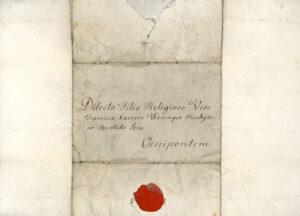
Figure 5. Addressed side of a letter from Pope Gregory XVI to Rev. Francis Xavier Weninger, S.J., 1844. St. Xavier High School Archives.
One of the greatest joys of the position has been sharing the school’s history with others, particularly through the use of historical articles featured in St. Xavier Magazine. Entitled “Excerpts from the Archives,” these short, one-page essays highlight interesting tidbits from the school’s historical record: secret societies, our first home football game, and the saga of a student called to France by Napoleon III, just to name a few.
Class reunions have likewise become an important part of the archives’ work. Historical photographs are used in slideshows while extra yearbooks and publications are made available for attendees. Reunions also have a wonderful way of bringing forgotten pieces of St. Xavier history back home. Alumni have donated everything from class rings and diplomas to clothing and publications. One alumnus even donated a pair of St. X boxer shorts from the 1970s. To date, they remain the only pair of underwear in the archives.
Perhaps no other part of my work has been more rewarding than serving as a resource for the wider St. Xavier community. During the 2025–26 school year alone, the archives received more than 200 research inquiries from individuals and organizations. Most requests came from within the school itself, but many also came from alumni and their families. A handful even came from individuals in other states and countries. Two early requests, in particular, are memorable.
The first came from a member of the Class of 1947. He reached out looking for a poem he had written as a student and published in The Xavier Prep, the school newspaper at the time. I had no idea whether I would be able to find it, but I promised to do my best. After sifting through several years of old student newspapers, I came across the small piece in the February 28, 1946, edition of the Prep. Thrilled that I had been able to locate it, I scanned the page and forwarded a copy to him. He was delighted to see his work once again, nearly eighty years after he had written it. To me, it was simply a short poem in an old school newspaper. To him, it was the return of something deeply personal.
Another request came from the Netherlands. The researcher, a volunteer for the Netherlands American Cemetery in Margraten, was helping prepare for “The Faces of Margraten,” a tribute held every two years in which photographs of the fallen are displayed beside their graves. The cemetery serves as the final resting place of more than 8,000 American service members who died during World War II.
Among those buried there is a member of St. Xavier’s Class of 1939, but cemetery staff had been unable to locate a photograph of him. Within seconds, I found his senior portrait in one of our yearbooks, scanned it, and sent it to the researcher.
The task itself took only a few moments, but the gratitude expressed by the researcher left a lasting impression. It was a powerful reminder that archival work often extends well beyond the walls of the archives themselves. I was honored to play a small part in preserving the memory of one of our alumni and honoring his sacrifice.
Of all the initiatives that have emerged from the archives, I am most proud of our oral history project. Every summer for the last five years, I have worked with student interns to record and preserve the stories of alumni from the 1940s, 50s, 60s, and 70s. Using yearbooks and school newspapers, the students research each alumnus before conducting an interview, either in person or over the phone. Typically lasting around an hour, the interviews focus on the St. Xavier experience: the decision to attend, favorite and least favorite classes, athletic events, homework, dances, clubs, and even JUGs.
The interviews are recorded, transcribed, and then preserved in the archives. They provide personal insights into student life during different eras and capture memories that seldom appear in official records. Every interview concludes with the same question: “Looking back, what reflections do you have on St. Xavier and its significance in your life?” As one might imagine, the responses tend to be thoughtful and deeply moving. Alumni may not always remember every teacher, class, or extracurricular, but they never forget what their St. X education means to them.
In August 2022, the St. Xavier Archives debuted social media accounts on Facebook and Instagram. By that point, thousands of images from photographs, slides, and 35mm film had been digitized, providing a wealth of material that could be shared with the wider St. X community. Social media offered a simple and direct way to highlight this visual record. Alumni, students, parents, and friends regularly comment on posts, share memories, help date photographs, and even provide names for individuals who have long gone unidentified.
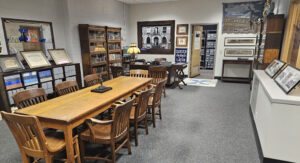
Figure 6. St. Xavier High School Archives, present day.
One unforeseen blessing of my work has been my connection with the Institute for Advanced Jesuit Studies (IAJS) at Boston College. I first became aware of IAJS back in 2022 when Fr. Millbourn told me about a “Jesuit Studies Café” featuring Fr. Festo Mkenda, S.J., Academic Director of the Roman Jesuit Archives. Sponsored by the Institute and held virtually throughout the year, the Cafés provide opportunities for informal conversations with scholars working in the fields of Jesuit history, spirituality, and education.[1] Fr. Millbourn suspected I would enjoy Fr. Mkenda’s talk, and he was absolutely right. What began as a single online presentation and discussion soon led to one of the most formative experiences of my professional life.
Following the Café, I discovered the Institute’s Certificate in Jesuit Studies. This graduate-level program offers a comprehensive exploration of the Jesuit tradition and includes an immersion experience in Spain and Rome, following in the footsteps of St. Ignatius and his early companions.[2] As an archivist at a Jesuit school, I immediately recognized the value of the program. I wanted not only to preserve St. Xavier’s history but also to understand more fully the Jesuit tradition that gave rise to it.
I completed the certificate program in July 2024, and the experience indeed deepened my understanding of both Jesuit history and Ignatian spirituality. But perhaps its greatest gift was perspective. I viewed the school’s history not as an isolated institutional story but as one chapter within the much larger history of the Society of Jesus.
My connection with IAJS through the Certificate program yielded other fruit as well. In the summer of 2024, I presented at the International Symposium on Jesuit Studies in Boston, and that fall, I hosted my own Jesuit Studies Café. These experiences introduced me to a vibrant community of scholars and educators dedicated to preserving and better understanding Jesuit history.
In the fall of 2025, I began pursuing a Master of Library and Information Science degree, giving me the opportunity to place the practical experience I have gained at St. Xavier over several years within a broader professional framework.
Challenges
The growth of the archives has brought about its own challenges, chief among them the reality of being a “lone arranger.” Larger institutions may have a mix of specialized staff, including processing archivists, reference archivists, digitization specialists, oral historians, and individuals dedicated to outreach and public engagement. As the sole staff member of the St. X Archives, my responsibilities range from arranging and describing material to answering research requests, digitizing records, managing oral histories, and interacting with the public. The challenge is not simply the number of responsibilities, but the need to continually balance the demands of the present with the long-term work of preserving the past.
This competing set of priorities is inherent in archival work. Some tasks are focused on building the archives for the future, while others serve the immediate needs of the school and community. Both are essential to the mission of the archives, and both compete for the same limited time. A research request may need an answer today, while digitizing a bound ledger can require weeks of careful work. Learning to accept that archival progress is often slow and methodical has been an important aspect of the job.
High school archives also remain relatively uncommon, and many educators understandably have little experience with them. St. Xavier High has been no exception. Over time, however, I have watched the archives become increasingly integrated into the daily life of the school. Faculty, staff, students, alumni, and administrators have increasingly recognized the archives as a resource that supports the school’s mission and preserves its memory.
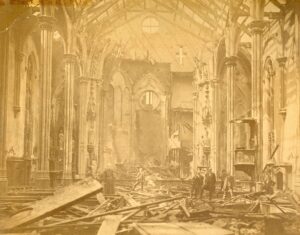
Figure 7. Photograph of the interior of St. Xavier Church following the fire of 1882. St. Xavier High School Archives.
The Future
One of the most exciting developments for the future has been the Class of 1967’s decision to endow the archives as its class gift. Once fully funded, the endowment will provide permanent financial support for both the archives and the archivist position, helping to ensure that the work of preserving St. X history continues for generations to come, long after my own work is finished.
The school is also preparing for a major building project that will include a new home for the archives. For the first time, the collection will occupy a space designed specifically for archival preservation, complete with environmentally controlled storage, high-density shelving, and a dedicated reading room. The prospect of moving into this new space is meaningful because it reflects the school’s ongoing commitment to its history and ensures that these records will remain accessible to the community.
The approaching bicentennial celebrations of St. Xavier High and Xavier University in 2031 also present exciting opportunities. Because the two institutions share a common history, the occasion will offer a unique opportunity to reflect on nearly two centuries of Jesuit education in Cincinnati. Although planning is still in its early stages, I look forward to the ways in which the archives will contribute to commemorating this historic milestone.
Epilogue
In preserving the history of St. Xavier High School, we are also helping preserve the broader history of the Jesuit apostolate in Cincinnati: St. Xavier College, St. Xavier Church, and even defunct institutions such as St. Xavier Parochial School and St. Xavier Commercial High School. These microhistories form part of the much larger story of Jesuit education in the United States, a story that is itself woven into the global history of the Society of Jesus.
As we face an uncertain future with a diminishing number of Jesuits serving in schools, sustaining our mission, identity, and way of proceeding becomes more important than ever. Archives play an essential role in that work. They preserve not only institutional memory, but also the values, stories, and traditions that have shaped Jesuit education through the centuries.
Writing this essay has given me the opportunity to reflect on a journey that started in October 2018 with a fragile student register and a single sheet of paper. What began as an idea eventually blossomed into a full-time position, opening doors to opportunities that have taken me around the world, from Boston to the streets of Rome and the mountains of Montserrat. This endeavor, though far from over, has succeeded beyond my wildest dreams, and I could not have done it without the help and support of numerous people along the way: President Tim Reilly, Fr. Rick Millbourn, S.J., and an untold number of colleagues, friends, and family members. It has truly been a team effort.
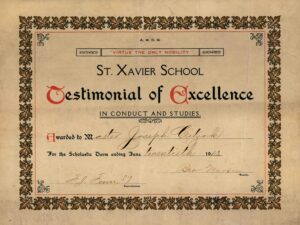
Figure 8. “Testimonial of Excellence in Conduct and Studies,” St. Xavier Parochial School, 1913. St. Xavier High School Archives.
Karl Hauck, whose dedication to preserving St. Xavier’s history helped lay the foundation for everything that followed, passed away in April 2022. I remain profoundly grateful for his foresight, perseverance, guidance, and friendship. The Class of 1967’s archive endowment is named in Karl’s honor, a fitting tribute to a man whose quiet work over the years ensured that so much of St. Xavier’s history would survive to be preserved and shared.
What excites me most is what remains ahead: the people I have yet to meet, the stories still to be uncovered, and the history still to be preserved.
Notes:
[1] “Jesuit Studies Café,” Institute for Advanced Jesuit Studies, accessed May 21, 2025, https://www.bc.edu/bc-web/centers/iajs/programs/jesuit-studies-cafe.html.
[2] “Certificate in Jesuit Studies,” Institute for Advanced Jesuit Studies, accessed May 21, 2025, https://www.bc.edu/content/bc-web/centers/iajs/programs/certificate-in-jesuit-studies-.html.
Institute for Advanced Jesuit Studies. “Certificate in Jesuit Studies.” Accessed May 21, 2025. https://www.bc.edu/content/bc-web/centers/iajs/programs/certificate-in-jesuit-studies-.html.
Institute for Advanced Jesuit Studies. “Jesuit Studies Café.” Accessed May 21, 2025. https://www.bc.edu/bc-web/centers/iajs/programs/jesuit-studies-cafe.html.
Title: From Curiosity to Vocation: Reflections on the St. Xavier High School Archives
Author(s): Nicholas Kemper
Article Type: Reflection on the Living Tradition
DOI: https://doi.org/10.51238/jeq.SO7jcBR
Language: English
Pages: 499–513
Keywords: –
In: Jesuit Educational Quarterly
In: 2nd ser., Volume 2, Issue 3
Received: 28 July 2026
Accepted: 20 August 2026
Publication Date: 16 October 2026
Last Updated: 16 October 2026
Publisher: Institute of Jesuit Sources
Print ISSN: 2688-3872
E-ISSN: 2688-3880
APA
Kemper, N. (2026). From curiosity to vocation: Reflections on the St. Xavier High School archives. Jesuit Educational Quarterly, 2(3), 499–513. https://doi.org/10.51238/jeq.SO7jcBR
CMOS
Kemper, Nicholas. “From Curiosity to Vocation: Reflections on the St. Xavier High School Archives.” Jesuit Educational Quarterly, 2nd ser., 2, no. 3 (2026): 499–513. https://doi.org/10.51238/jeq.SO7jcBR.
MLA
Kemper, Nicholas. “From Curiosity to Vocation: Reflections on the St. Xavier High School Archives.” Jesuit Educational Quarterly, 2nd ser., vol. 2, no. 3, 2026, pp. 499–513. https://doi.org/10.51238/jeq.SO7jcBR.
Turabian
Kemper, Nicholas. “From Curiosity to Vocation: Reflections on the St. Xavier High School Archives.” Jesuit Educational Quarterly. 2nd ser., 2 (3): 499–513. https://doi.org/10.51238/jeq.SO7jcBR.