



Kádár, Zsófia. “Students Outside the Classroom: Housing, Eating, and Behaving in the (Grammar) Schools of the Austrian Jesuit Province Around 1670–1740.” In “Renovatio Mundi: The Jesuits as Educators in History (Proceedings of the Symposium held at Boston College, June 11–13, 2024),” ed. Cristiano Casalini, Alessandro Corsi, and A. Taiga Guterres, special issue, International Symposia on Jesuit Studies 4, no. 1 (2026): e03. https://doi.org/10.51238/ISJS.2024.03.
 Open Access

Abstract
Full Article
Metadata
Cite
Abstract
The surviving grammar school registries of three former West-Hungarian schools (Győr, Bratislava/Pressburg and Trnava) were processed and analyzed by a Hungarian research group, resulting in a database of about 68,000 students. We also tried to understand the functioning of seminaries and convicts. However, it became clear that around four-fifths of the students did not live in such boarding schools, but were housed in citizens’ houses, receiving food from home or begging for their daily bread by singing. We can gain insight into the difficulties of feeding and housing, not to mention the conflicts between the citizens and the students. According to documents from the Trnava municipal archives, some students have been caught fighting, stealing, confronting local citizens, and meeting suspicious women. The town council and the Jesuit college took steps against the perpetrators—while the issue of jurisdiction over the students was a subject of heated debate.
Keywords:
Jesuit grammar schools; Province of Austria; Habsburg Monarchy; convicts and seminaries; students’ behavior
Full Article
Introduction
“Rather than singing under windows like students do today, I am going to pilfer.”[1] In 1692, Antal Haulicza, a student of metaphysics, announced this in front of the Trnava town magistrate after he and two syntaxist fellows had been caught repeatedly stealing and in the company of certain “promiscuous women.” The incident is interesting not because it should be considered typical but because it highlights a common problem that is nevertheless difficult to examine: the challenges of housing and obtaining food for the student population of the time. The contemporary royal free town of Trnava had a population of about two thousand to three thousand inhabitants. However, after 1543, due to the Ottoman conquest, it temporarily became the ecclesiastical center of the Kingdom of Hungary, a so-called “little Rome.”[2]
Initially, in addition to the archbishop of Esztergom and the chapter, there were two monasteries of medieval origin in the town, namely the Franciscans and the Poor Clares. After the foundation of the Jesuit college (1616) and university (1635),[3] Pauline and Benedictine study houses were built as well. In the early eighteenth century, two further religious houses were founded: one for the Trinitarians and one for the Ursulines.[4] If we take into account that the number of Jesuits in the town amounted to eighty in 1720 and 140 from the 1740s onward, with eight hundred to one thousand students attending the grammar school, as well as the philosophy and theology faculties each year, it can be observed that not only was the life of the town transformed by the Catholic institutions; they also radically altered its daily life. Although the students were served by five convictus (boarding schools) and seminaries, most of them stayed with relatives or in burgher houses. Consequently, their presence restricted the daily life of the townspeople and placed a heavy burden on the local community.[5]
Trnava is just one example from the Austrian Jesuit province (founded in 1563). However, it has many parallels with other Jesuit schools and universities in terms of the students’ daily life. Pranks and major misdemeanors by students in other colleges of the province have also been documented from time to time, either in Jesuit sources (e.g., correspondence) or in the records of local municipal magistrates. We know of such cases, for example, from Zagreb from the seventeenth century and even from Vienna, the center of the province.[6] Conflicts over jurisdiction often arose between the Jesuit college (and its related academy or university) and the town authorities regarding guilty students.
The following analysis does not focus on the students’ list of crimes; I consider their activities primarily as “symptoms.” My goal is to answer how these offenses are linked to the issues of housing and food consumption. It is a commonplace that the extensive Jesuit school system, which provided education for free, played a key role in the seventeenth- and eighteenth-century Habsburg monarchy. Even in the eighteenth century, the Society’s (quasi-) monopoly on secondary education was gradually and moderately reduced, and in the Kingdom of Hungary, it was maintained until the suppression of the Society in 1773.[7]
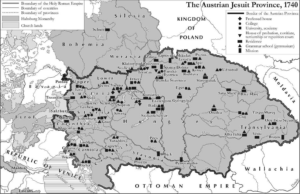
Figure 1. The Austrian Jesuit province in 1740. Concept of the map: Zsófia Kádár; design: Béla Nagy.
From the institutional history of the entire Austrian province, I describe here the status around 1740, which is relevant to our subject. At that time, the Jesuits had a total of thirty-eight grammar schools, but not all of them were complete, six-level schools.[8] Of these schools, thirteen offered higher philosophical and/or theological education, with full universities under the direction or significant influence of the Society in Vienna, Graz, Trnava, and Košice. For comparison, in 1773, the number of secondary schools was even greater: forty-five full and seven smaller grammar schools were in operation in the year of the order’s suppression.[9] In 1740, according to the annual province catalog, there were 144 masters and eighteen priests teaching in grammar schools, and 104 Jesuits teaching at the academic level. The numbers of students are only partly known (I will return to this below), so I quote here the numbers for 1773. The nine large grammar schools in the western (“Austrian”) half of the province had a total of 3,646 pupils, and the ten large grammar schools in the eastern (“Hungarian”) half had 3,682 pupils. Based on external control sources, according to László Szilas, S.J., about three to four percent of the Hungarian male population aged thirteen to seventeen attended Jesuit gymnasia, suggesting a broad impact and social acceptance of the Society even in the year of the suppression.
Relatively little is known about the daily life of this large crowd of students. The students’ extracurricular activities are difficult to ascertain, especially those of the groups that were more or less outside the close supervision of the Jesuit magistrates and largely interacted with the members of the order only in the classroom. The present study is an attempt to gain a picture of the different groups of students, particularly in terms of housing and obtaining food. It also aims to highlight some of the links between these issues and the students’ pranks, as well as the complex and sometimes conflicting relationships between the Jesuit institutions and the local society of the host town.
The paper builds on the results of two long-term projects. On the one hand, it utilizes the work of a research group analyzing the student population of Western Hungarian Jesuit grammar schools. This group recorded data from contemporary school registers in databases, providing a comprehensive picture of the three aforementioned schools.[10] The second project is an analysis of the institutional history of the entire Austrian province, aiming to compile a cadaster of the Jesuit domiciles.[11]
Some Lessons from the School Registers: The Examples of Three Western Hungarian Jesuit Grammar Schools
Let us begin with some key data from the Western Hungarian grammar school databases. While publications and related analyses on university students date back many decades,[12] very little is known about the much larger population of pupils attending Jesuit grammar schools. The almost completely preserved registers of three former Jesuit grammar schools in Western Hungary have been processed into three databases, providing a comprehensive picture of this region’s student population from 1616/30 to 1773. A total of 181,336 enrollments were recorded, covering 68,647 people.[13] (The number of students and the number of enrollments from the three grammar schools are as follows: Trnava: 28,650 students and 71,098 enrollments; Pressburg: 19,402 students and 50,667 enrollments; Győr: 20,595 students and 59,571 enrollments.)
The average number of students varied from school to school. After the Great Turkish War (1683–99) and Rákóczi’s War of Independence (1703–11), the Kingdom of Hungary was at a demographic low; it was only after this period that the numbers of students begin to increase (again). At the Pressburg grammar school, the average number of students was 310 between 1650 and 1710 and 530 between 1711 and 1773. At the Győr Jesuit school, the average number of students was 324 between 1630 and 1710 and 452 between 1711 and 1773. In the case of the grammar school in Trnava, there were minor fluctuations within the seventeenth- and eighteenth-century data series but without marked differences, averaging 570 to 578 students per year (excluding school years for which rolls are incomplete or missing).[14]
We have only sporadic data on the average age of students from the three Western Hungarian schools. Boys of varying ages may have studied in the same class, based on their similar level of knowledge. Nevertheless, the average age of each year group increased gradually from the lowest class to the rhetoric class, with typically nine- to twelve-year-olds entering the school (average age in the “parvistae” class was 11.9 years), and seventeen- to twenty-one-year-olds graduating from the rhetoric class (where the average age was 18.8 years).[15]
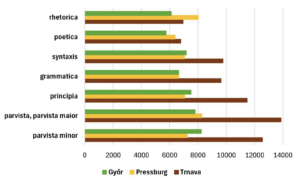
Figure 2. The total number of students per class in the three Western Hungarian Jesuit grammar schools (1616/1630/1650–1773).
The classic five-year Jesuit grammar school in the region was typically supplemented by lower, so-called “parvistae” classes, providing a transition between primary and secondary education. The class pyramid of the three schools shows the total number of students attending each year group. The graph shows that the lowest classes were the most populous (it should be noted here that the “parvista” rolls are often incomplete), followed by a gradual decrease in the number of pupils who progressed to the (middle) grammar classes. A similar drop in numbers is typical after syntax, before the so-called “humaniora” grades: the poetics class is the smallest in all three schools. The higher number of rhetoric students can be explained by two factors: on the one hand, this class was repeated by students more often than poetics. On the other hand, in all three towns, new students from other grammar schools often attended only the rhetoric class. In Győr, for example, there was an influx of students from the grammar school in Gyöngyös, which was in the Ottoman territory.[16] Pressburg was attractive to students due to the presence of the Hungarian central government institutions: completing a rhetoric class here could provide a good starting point for a career in the Hungarian Chamber. Moreover, the University of Trnava was appealing to students because further higher education could be pursued there.
A burning question is whether the Jesuit grammar schools, which provided free tuition and were the densest secondary school network in the Habsburg monarchy in the seventeenth and eighteenth centuries, served as a means of social mobility or promoted the reproduction of the feudal classes. Leaving this question open, let us now discuss some incomplete data on the social status of the students from the three schools.
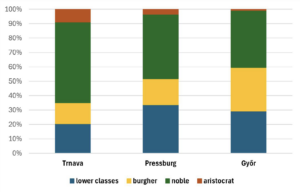
Figure 3. The total proportion of students per social group in the three Western Hungarian Jesuit grammar schools (1616/1630/1650–1773).
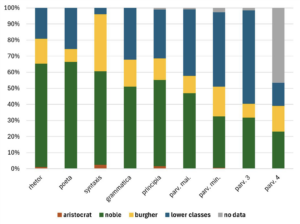
Figure 4. The distribution of students by social groups and school classes, Trnava, 1697.
As can be seen, nobles and aristocrats, who are much more frequently noted in the school registers, formed a majority only in Trnava—though this may also be a consequence of the lack of sources—while the proportion of burgher and commoner classes exceeded that of the nobles in both Pressburg and Győr. However, highlighting the data for a single representative sample year, 1697 in Trnava, we can see that the proportion of nobility increased with the higher classes, suggesting that completing the gymnasium and further academic studies was primarily the goal and privilege of the nobility.
Further research is necessary to understand the mobility of students between grammar schools, but it is already clear that students often graduated from two or three different grammar schools in different towns. A possible motivation in this multi-ethnic region could have been the opportunity to learn languages, which may have regularly led Slovak-speaking youths to attend school in the Hungarian-speaking episcopal seat and fortress town of Győr. The high proportion of local grammar school students continuing their studies at the local university is evident in the case of Trnava: a cohort of students who completed the rhetoric class between 1656 and 1660 shows that around 60 percent of them started their academic education at the local philosophy faculty.[17]
The place of origin (“patria”) of students was also a determinant of their schooling. Although the geographical range of the West Hungarian grammar schools was large, most of the pupils came from the towns themselves and the surrounding county or counties. Győr’s geographical influence also extended into the Turkish-occupied regions of the Kingdom of Hungary during the seventeenth century. By mapping the place of origin of students in Győr, Pressburg, and Trnava, we can see that the tendency for students to live locally, in the school town or in the nearby area, was much greater: it was simply easier for the family to finance the cost of housing and food in the town.[18]
Research on the normative sources of Jesuit schooling, institutional history, and the student body overlooks the background of the students’ everyday life: the institutional network of seminaries and convictus, and the daily life of pupils accommodated in burgher houses. This is partly due to the lack of contemporary sources: the archival records of the convictus were even more dispersed after the suppression of the Society than the documents on former Jesuit estates and institutions, which came under state administration.[19] Additionally, the complexity of the subject may contribute to this oversight: the role of the convictus is often seen in the context of local history, which makes a comparative study difficult. Unfortunately, at the present stage of research, we do not yet have a complete picture of Jesuit convictus and seminaries for the entire Austrian province, unlike the Jesuit grammar schools.
However, the Jesuit annual reports, house histories (historiae domus), and school diaries (matriculae or catalogi studiorum), as well as the documents of the students’ Marian congregations, show that most pupils were focused on activities such as study, prayer, and devotion. On holidays, they participated in processions, singing, and carrying torches, and in almost every semester, they put on highly successful theatrical performances for local dignitaries and townspeople. However, the Jesuit reports (because of their own criteria, regularities, and aims) are understandably biased: they show only one side of the coin. In the following, I therefore use Jesuit documents and other external sources to answer the question raised at the beginning: Where were the numerous students attending Jesuit grammar schools (and academies) accommodated, how did they eat, and what kinds of misdemeanors did they pursue in their free time?
The Size of the Student Population and the Number of Students Living in Seminaries or Convicts in 1738/39
Due to the large size of the Austrian province, it is difficult to develop an accurate image of the total number of students reached by the entire Jesuit school network each year. Based on the annual reports of 1739, the student numbers of forty-four gymnasia are known, while no data are available for seven further schools.[20] Twenty-nine schools were attached to colleges and the rest to residences. There are large variations in the numbers of students: the gymnasium, philosophy, and theology students at the Viennese Academic College attracted the largest number, about two thousand, followed by the university and gymnasium of Graz with about thirteen hundred students. Third was the university and gymnasium of Trnava with around one thousand students. Four colleges in Laibach, Pressburg, Klagenfurt, and Zagreb also had a high student population of around six hundred to eight hundred. Among them, Pressburg was a special case, because it was exclusively a grammar school, without academic classes. Around 250 to five hundred students were enrolled per year in the major gymnasia, while half of the schools had fewer pupils. Notable is the large number of grammar schools in several Hungarian Jesuit residences, which are mixed in with the grammar schools of the colleges: in other words, some residences had larger grammar schools than some colleges. The average number of students per school is 362 for all schools and 479 for the schools of the colleges only.
Unfortunately, the annual reports provide only incomplete data on students who lived in seminaries or convictus. Additionally, an uncertain point is whether the costs of the “alumni” were paid totally or mainly by the institution (these were the so-called foundation places), while the “convictors” paid for their own accommodation, and therefore the latter group is not always included in the total number of pupils who lived in the boarding schools. Nevertheless, it can be seen from Table 2 that in the western part of the province (houses marked with a star), the proportion of residents in convictus and seminaries was typically higher than in the east, in the Kingdom of Hungary, with around fifteen to thirty percent. In Hungary, the proportion was about five to fifteen percent.
It is also worth noting that the Bohemian Jesuit province (separated as an independent province in 1623), which was about half the size of the Austrian one, has more detailed data on the number of students in grammar schools, seminaries, and convictus than the Provincia Austriae. We can therefore refer here to the relevant research of Kateřina Bobková-Valentová as a parallel.[21] The size of the Jesuit grammar schools in the Bohemian province also varied, with typically 150 to three hundred students per year, roughly the same as in the Austrian province. The total number of students in seminaries and convictus, the number and proportion of “alumni” and “convictores,” also varies widely. The proportion of residents in convictus (where they existed at all) ranged from ten percent to fifty-six percent (on average between ten and 113 boys). The lowest proportion is known from the “Kleinseite” part of Prague, and the highest from the seminary in Jičín, a town in northern Bohemia. The number of foundation places available in the convictus did not depend on the size of the town but on other factors—the Bohemian example focuses our attention on the role of the founders of the boarding houses: the size of the foundation capital and estates determined the capacity, thereby the possibilities for the students.
One unique source from the Kingdom of Hungary can be used to control the above-presented data of the Austrian Jesuit province.[22] In 1738/39, a Hungarian central government institution, the Locumtenential Council, requested a complete list of students enrolled in the kingdom’s grammar schools. This was partly due to the threat of epidemics and partly to prevent poor pupils from “wandering” between schools, with the list used to inform a decree restricting the migration of these students. Although the latter was never realized, the school rolls have survived, providing a detailed overview of the country’s student population from a single school year. Here, I will only highlight the data on housing and maintenance, which can be placed alongside the Jesuit annual reports. We only have both data from four schools showing the number of all students and all residents of the convictus and seminaries. This means that only these schools can be compared using our different (Jesuit and governmental) sources: Buda, Trnava, Eger, and Sopron.
Trnava and Eger show different proportions in the two sources, while the figures for Buda and Sopron are roughly the same in the two source types. The discrepancy is explained by the fact that the student census includes (almost) only grammar school students, and only “alumni,” namely those who were supported by the foundations, are included among the inhabitants of the convictus.[23] The two sources are not identical in all respects, but they are compatible. This means that, with certain limitations, we can draw conclusions about the conditions in the western part of the province based on the more detailed data from Hungary. If we now consider the entire data set of the Hungarian student census, the following groups of students can be identified in terms of food consumption and accommodation.[24]
The aggregated data from nine schools clearly show the advantage of having a family living in or near the town, allowing students to eat and sleep at relatives’ houses. If we add to the 62.7 percent group of students whose living costs were covered by their family, those whose family signed a contract with a burgher and paid him regularly (10.6 percent), and, say, half of those who could not be categorized as either begging or receiving food from home (in total 7.7 percent, half 3.85 percent), we reach 77.15 percent. Only about 20 percent of the students relied on charitable foundations, other benefactors, help from the Jesuit college, or their own work. Even among them, students in the most precarious situations were those who regularly had to beg for meals or sing “under other people’s windows,” like the students from Trnava mentioned at the beginning of the article.
A Case Study: Complaints Against the Students of Trnava
For now, I will focus on this group, which made up five to ten percent of all students, and return to Trnava. Between 1673 and 1692, there was a whole catalog of crimes, with the burghers complaining a great deal about the pupils. Both the Jesuit college and the magistrate of the free royal town claimed the right to judge the guilty.
According to a report of witnesses, the following complaints were made against the students.[25] In 1691, armed students released two prisoners sentenced to death from the town prison and took them to the local Franciscan monastery. In the same year, during a great feast, when believers were gathering in the Jesuit church, a poor man was dragged from the house of a Protestant citizen and thrown into the Trnavká stream. During a town market in 1692, the students fought with German soldiers, broke the windows and doors of a woman’s house to harass the Germans there, smoked them out while hiding in the chimney, dragged them off the roof, and beat them. In 1689, they also fired at German soldiers in the marketplace, wounding several people. They dragged town councilors into the college and tried to beat them. Before 1678, a German traveling salesman was also attacked. A servant of the local chapter was killed in 1673, yet the guilty students were not sent to the town prison but only expelled from the town. All the fruit trees in a citizen’s suburban garden were cut down. Some students went out regularly to fight in the suburban vineyards and orchards, causing burghers to say it was dangerous to work alone in the suburbs. Around 1678, the students loudly insulted the town guards, killing three of them on another occasion. According to witnesses, the students appealed to the Jesuit fathers and teachers for protection and were never properly punished by the college or the town magistrate for their actions. This contributed to the recurrence of the scandalous incidents. The mentioned scandals caused a great uproar: a letter from György Széchényi, archbishop of Esztergom, to the Jesuit rector Márton Szentiványi has survived, in which the prelate asks the rector to recognize the town’s jurisdiction over the guilty students, at least in certain serious cases.[26]
The case of the already mentioned Antal Haulicza and his two companions, István Tapolczany and Mihály Madarász, is also known in more detail.[27] The metaphysician and two syntaxist students broke into three burgher houses in a single night in early 1692. First, they stole bacon and other foodstuffs from a local goldsmith, the forty-six-year-old Gergely Eötvös Horváth. Then they drained some wine from the cellar of the forty-year-old widow of Jakab Rost, Katalin Bucsány. Some of the stolen wine belonged to another burgher. Finally, they stole some clothes from the courtyard of István Károly, an elderly nobleman. Thereafter, on the same night, they were caught in a fourth burgher’s house, in the mansion of János Ocskay, by the town guards in the company of certain “promiscuous women.” The entire group was taken to the town hall with the stolen goods. It was here that Haulicza’s phrase, quoted at the beginning, was said: “Rather than singing under windows like students do today, I am going to pilfer.”
Haulicza’s defiant act points to the little-known aspect of student life that we have discussed above: the issue of housing and obtaining food. Given the circumstances, Haulicza must have been one of those students who had no accommodation in a convictus or seminary and inadequate help from their families to provide both accommodation and food. They therefore had to beg for part or all of their daily bread. In a town the size of Trnava, this created serious tensions between the students and the local townspeople, which posed a constant challenge for Jesuit teachers and superiors alike.
Instead of a Conclusion: Some Considerations for Further Research
Although my analysis did not provide a complete answer to the questions raised at the beginning, some aspects may be useful for similar research. (1) Student numbers, their changes, and the class structure must be analyzed in relation to local towns. What size of town hosts the student population and the Jesuit institution? Does the presence of the school improve the local infrastructure, or, in contrast, does it overburden the town? (2) Within the Jesuit school network, which had a uniform structure and provided free education, there could have been significant differences, even regionally. The social groups making up a school’s population, the proportion of nobility and burghers among the students, and the typical schooling strategies must be the subject of local research. (3) Special research should be directed at the convictus and seminaries, the local provision of students, the role of families, other benefactors, and ecclesiastical institutions. Who would have thought (as shown in the case of Trnava) that Franciscan and Trinitarian monasteries and Clarisse and Ursuline convents housed some of the boys? (4) The advantages for local students and the difficulties for poor students moving to the town from faraway localities are also shown. The distribution of food to “soup students” in the Jesuit colleges (as mentioned in the literature) affected only a very small group. The students’ misbehavior also highlights the limitations of the Jesuit school system. Finally, to formulate a quasi-hypothesis: the sources concerning students show that the Jesuit colleges and teachers had close control over those boys who lived in the convictus and seminaries. They were, however, a small minority. To uncover the daily life of the great majority, it is essential to consult not only Jesuit documents but also external sources.
| Town (coll./res.) | Students | Town (coll./res.) | Students |
| *Wien, Coll. Acad. | 2,000 | Gyöngyös R | 188 |
| *Graz | 1,372 | *Krems | 181 |
| Trnava | 1,000 | Esztergom R | 161 |
| *Ljubljana | 807 | Užhorod (Ужгород) | 160 |
| Pressburg (Bratislava) | 785 | Žilina R | 156 |
| *Klagenfurt | 622 | *Wiener Neustadt | 152 |
| Zagreb | 600 | *Steyr | 140 |
| *Passau | 530 | *Gorizia | 133 |
| Győr | 523 | Požega | 130 |
| *Linz | 477 | Komárno R | 130 |
| Eger | 400 | Székesfehérvár R | 127 |
| Kőszeg | 400 | *Leoben | 121 |
| Košice | 386 | Rožňava R | 120 |
| *Rijeka (Fiume) | 360 | Oradea (Nagyvárad) R | 100 |
| Varaždin | 350 | Spiš R | 90 |
| *Wien, Professed House | 336 | Sárospatak R | 62 |
| Buda | 327 | Baia Mare (Nagybánya) R | 55 |
| Sopron | 309 | Târgu Mureș (Marosvh.) R | 25 |
| Pécs | 308 | Millstatt R | 16 |
| Prešov R | 300 | ||
| Levoča | 205 | average number of students per school | 362 |
| Banská Bystrica | 204 |
Table 1. The total number of students in the schools of the Austrian province in 1739 based on the annual reports.[28]
| Litterae annuae 1739 | Student census in Hungary, 1738/39 | |||||
| Alumni | Student | % | Alumni | Student | % | |
| *Gorizia | 48 | 133 | 36.1 | |||
| *Leoben | 34 | 121 | 28.0 | |||
| *Krems | 43 | 181 | 23.7 | |||
| *Rijeka (Fiume) | 62 | 360 | 17.2 | |||
| Buda | 52 | 327 | 15.9 | 46 | 250 | 18.4 |
| *Wien, Coll. Acad. | ca. 275 | ca. 2,000 | 13.7 | |||
| *Steyr | 19 | 140 | 13.6 | |||
| Trnava | >129 | >1,000 | 13.0 | 36 | 513 | 7.0 |
| *Graz | 149 | 1,372 | 10.9 | |||
| Eger | 30 | ca. 400 | 7.5 | 47 | 281 | 16.7 |
| Sopron | 23 | 309 | 7.4 | 18 | 285 | 6.3 |
| Varaždin | 18 | 350 | 5.1 | |||
Table 2. The total number of the alumni and students in some schools of the Austrian province in 1739 based on the annual letters and the Hungarian student census.[29]
| Group | Explanation | Original description | Student | % |
| From home | The cost of living is covered by the family, the student lives in the school town or is staying with a relative living there. | domo, domi suae, domum vivit, domesticus, habet victum | 2066 | 62.7 |
| Begging/from home | The cost of living may be covered by the family, but it is uncertain, and the student may resort to begging. | conducta mensa, conductum victum | 254 | 7.7 |
| With contract | In order to support the student, the family signs a contract with a burgher and pays him regularly. | conditio victualis | 350 | 10.6 |
| For service | The student owes service for his accommodation and food (e.g., musical performance, singing, or as a preceptor). | obsequium, ex officio, musicus, discantista, cantu constanter, praeceptor | 165 | 5.0 |
| “Soup student” | He receives regular food donation (“soup”) from the Jesuit college, rarely from another local ecclesiastical institution. | iusculus | 127 | 3.9 |
| Alumni | The student lives and eats in a (Jesuit-led) convictus or seminary. | alumnus, convictus | 216 | 6.6 |
| From benefactors | The student receives food (and accommodation) from a private benefactor or a local (non-Jesuit) religious institution (cloister, nunnery). | beneficio patronum, apus Franciscanos, apud moniales | 79 | 2.4 |
| From Jesuit college | The student receives food and accommodation from the Jesuit college, in rare cases in exchange for services. | in collegio | 39 | 1.2 |
Table 3. Groups of students in terms of food consumption and accommodation based on the Hungarian student census of 1738/39.[30]
Funding Information:
The article was written with the support of the Austrian Science Fund, “ESPRIT”-project no. 475-G.
Notes:
[1] “Semmint ablakok alá járna énekölni mai diákok módjára, inkább fog lopni.” Regional State Archive of Trnava (Štátny archív v Trnave), Trnava Town Magistrate (Magistrát mesta Trnavy), Scholastica, Box 1 (1541–89), pp. 87–89. Witness testimony (original, Hungarian) taken by László Beniczky iudex nobilium (noble judge) and János Paxy iuratus assessor (assessor) of Pressburg County.
[2] The number of tax-paying burghers in the mid-eighteenth century was around nine hundred. Cf. György Granasztói, A barokk győzelme Nagyszombatban: Tér és társadalom 1579–1711 [The triumph of the baroque in Trnava: Space and society 1579–1711], Város- és társadalomtörténet (Akadémiai, 2004), 20. For a useful summary of the history of the town as ecclesiastical center, see István Fazekas, “Az Esztergomi Főegyházmegye és Nagyszombat a kora újkorban” [The archdiocese of Esztergom and Trnava in the early modern period], in Visszatérés a magyar Sionra: Tanulmányok az érseki szék Esztergomba történt visszatérésének 200. évfordulója alkalmából [Return to the Hungarian Zion: Studies on the two-hundredth anniversary of the return of the archbishop’s see to Esztergom], ed. András Fejérdy and András Hegedűs, Strigonium Antiquum 11 (Prímási Levéltár, 2022), 6–27.
[3] There had already been a Jesuit college and school in Trnava between 1561 and 1567, but it was closed for lack of sufficient foundations and suitable members after a town fire and an epidemic. Cf. János Péteri [Antal Petruch], Az első jezsuiták Magyarországon (1561–1567) [The first Jesuits in Hungary, 1561–67] (n.p., 1963).
[4] Fazekas, Az Esztergomi Főegyházmegye, esp. 19–21, 25–26.
[5] The history of the Trnava college, the school, and the database of the students were published in traditional form and online; see István Fazekas et al., A nagyszombati jezsuita gimnázium diáksága: Anyakönyvi adattár (1616–1772) [The students of the Jesuit grammar school in Trnava: A database based on the register of students, 1616–1773], vols. 1–3, Katolikus iskoláztatás a kora újkori Magyarországon 3 (Jézus Társasága Magyarországi Rendtartományának Levéltára, 2023), esp. 9–66, https://leveltar.jezsuita.hu/hu/nagyszombat (accessed May 3, 2026).
[6] Miroslav Vanino, Isusovci i hrvatski narod, vol. 1, Rad u XVI stoljeću Zagrebački kolegij [The Jesuits and the Croatian folk, vol. 1, The activities at the College of Zagreb in the sixteenth century], Bibliotheca Fontes et Studia historiae Societatis Iesu inter Croatas 1/1 (Filozofsko-teološki institut Družbe Isusove, 1969), 137–38. The only example from Vienna is the riot of the Hungarian clerics of the Jesuit-led Seminarium Pazmanianum in 1709 that broke out because of the reduction of wine rations; see István Fazekas, “A Pázmáneum története az alapításától a jozefinizmus koráig (1623–1784)” [The history of the Pázmáneum from its beginnings to the time of the Josephinism, 1623–1784], in A bécsi Pázmáneum [The Pázmáneum in Vienna], ed. István Zombori, METEM Könyvek 37 (METEM, 2002), 9–176, here 36–41. For more information on student disciplinary offenses in the German region, see for example Bernhard Duhr, Geschichte der Jesuiten in den Ländern deutscher Zunge, vol. 3, In der zweiten Hälfte des XVII. Jahrhunderts (Verlagsanstalt vorm. G. J. Manz, 1921), 439–52.
[7] For Hungarian and Austrian summaries of the early modern Jesuit school system, see J. Aurelián Hets, A jezsuiták iskolái Magyarországon a 18. század közepén [Jesuit schools in Hungary in the middle of the eighteenth century], Publicationes ad historiam S.J. in Hungaria illustrandam, Lucubrationes 5 (Pray Rendtörténetíró Munkaközösség, 1938); Helmut Engelbrecht, Geschichte des österreichischen Bildungswesens: Erziehung und Unterricht auf dem Boden Österreichs, vol. 2, Das 16 und 17. Jahrhundert (Österreichischer Bundesverlag, 1983), esp. 122–214.
[8] Cf. László Lukács, ed., Catalogi personarum et officiorum provinciae Austriae S.I. (Institutum Historicum S.I., 1994), 8:363–424.
[9] László Szilas, “Die österreichische Jesuitenprovinz im Jahr 1773: Eine historisch-statistische Untersuchung,” part 2, Archivum historicum Societatis Iesu 47 (1978): 297–349, here 302–4.
[10] Consecutive projects on the students of Jesuit grammar schools in Western Hungary were supported by the National Research, Development, and Innovation Office of Hungary (project nos. K 116116 and K 131973). Principal investigator: István Fazekas.
[11] Supported by the Austrian Science Fund (FWF) “Lise Meitner”-project no. M-3041 and a subsequent, thematically related project “ESPRIT” ESP 475-G. Principal investigator: Zsófia Kádár.
[12] Examples include the publication of the Vienna University matricula and the (re-)publication of the student register of the University of Trnava. Cf. Franz Gall et al., eds., Die Matrikel der Universität Wien, vols 1–8, Publikationen des Instituts für Österreichische Geschichtsforschung, Reihe 6, Quellen zur Geschichte der Universität Wien, Abteilung 1, Die Matrikel der Universität Wien (Böhlau, 1956–2014); Adrien Kmety, László Szögi, and Júlia Varga, A Nagyszombati Egyetem bölcsész és teológus növendékei 1635–1735, 1736–1777 [The students of philosophy and theology at the University of Trnava, 1635–1735, 1736–1777], vols. 1–2, Felsőoktatástörténeti Kiadványok új sorozat 22, Strigonium Antiquum 9 (Esztergom: Prímási Levéltár–ELTE Egyetemi Könyvtár és Levéltár, 2021).
[13] I have already referred to the Trnava database (cf. note 5). See the other two database publications and related analyses in István Fazekas, Zsófia Kádár, and Zsolt Kökényesi, A győri jezsuita gimnázium diáksága: Anyakönyvi adattár (1630–1773) [The students of the Jesuit grammar school in Győr: A database based on the student register, 1630–1773], vols. 1–2, Katolikus iskoláztatás a kora újkori Magyarországon 1 (JTMRL, 2020), https://leveltar.jezsuita.hu/hu/anyak_adattar_1 (accessed May 3, 2026); Fazekas, Kádár, and Kökényesi, A pozsonyi jezsuita gimnázium diáksága: Anyakönyvi adattár (1637/1650–1773) [The students of the Jesuit grammar school in Pozsony/Pressburg/Bratislava: A database based on the student register, 1637/50–1773], vols. 1–2, Katolikus iskoláztatás a kora újkori Magyarországon 2 (JTMRL, 2021), https://leveltar.jezsuita.hu/hu/pozsonyi_adattar_1 (accessed May 3, 2026). The sources of the historical (statistical) data discussed below are the three mentioned databases.
[14] István Fazekas, Zsófia Kádár, and Zsolt Kökényesi, “Eine sozialgeschichtliche Analyse von Gymnasien-Schulmatrikeln: Schüler-Datenbanken der Jesuitengymnasien zu Tyrnau, Pressburg und Raab im 17/18. Jahrhundert; Ein Forschungsbericht,” Mitteilungen des Instituts für Österreichische Geschichtsforschung 130, no. 1 (2022): 71–101, here 84–87; Zsófia Kádár, “A nagyszombati jezsuita kollégium, gimnázium és tanulói (1616–1773)” [The Trnava Jesuit college, grammar school, and its students, 1616–1773], in Fazekas et al., A nagyszombati jezsuita gimnázium diáksága, 9–66, here 48–49.
[15] Fazekas, Kádár, and Kökényesi, “Eine sozialgeschichtliche Analyse,” 87–88; Kádár, “A nagyszombati jezsuita kollégium,” 51.
[16] The Jesuit school in Gyöngyös was the most important Catholic grammar school in the Ottoman-occupied territories of the Kingdom of Hungary. From the 1640s, it operated with two hundred to 350 students per year, and from 1647 a rhetoric class was also introduced. Cf. Antal Molnár, Mezőváros és katolicizmus: Katolikus egyház az egri püspökség hódoltsági területein a 17. században [Market town and Catholicism: The Catholic Church in the occupied territories of the diocese of Eger in the seventeenth century], METEM Könyvek 49 (METEM, 2005), esp. 171–77.
[17] Kádár, “A nagyszombati jezsuita kollégium,” 51.
[18] See the maps in Fazekas, Kádár, and Kökényesi, A pozsonyi jezsuita gimnázium, 67; and Fazekas, Kádár, and Kökényesi, A győri jezsuita gimnázium, 32–33.
[19] On the destruction of the archival documents of the former Austrian Jesuit province after 1773, see Walther Latzke, “Die Klosterarchive,” in Ludwig Bittner et al., ed., Inventare des Wiener Haus-, Hof- und Staatsarchivs, vol. 6, Gesamtinventar des Wiener Haus-, Hof- und Staatsarchivs, Dritter Band des Gesamtinventars, Inventare österreichischer staatlicher Archive 5 (Verlag Adolf Holzhausens Nachfolger, 1938), 293–698, esp. 325–31, and Ferenc Maksay, A Magyar Kamara archívuma [Archives of the Hungarian Chamber], A Magyar Országos Levéltár kiadványai 1/8 (Magyar Országos Levéltár, 1992), 44–47.
[20] Austrian National Library (Vienna), Manuscript Collection (=ÖNB) Cod. 12133. (Litterae annuae 1739), fols. 60–67 (Tit. 11).
[21] Kateřina Bobková-Valentová, “Studienstiftungen für Schüler der Jesuitenschulen der Böhmischen Ordensprovinz,” in Schulstiftungen und Studienfinanzierung: Bildungsmäzenatentum in der böhmischen, österreichischen und ungarischen Ländern, 1500–1800, ed. Joachim Bahlcke and Thomas Winkelbauer, Veröffentlichungen des Instituts für Österreichische Geschichtsforschung 58 (Böhlau, 2011), 231–51, here 237–38.
[22] The publication of the student rolls: Zoltán Fallenbüchl, Az 1738/39. évi országos diákösszeírás [The national student census of 1738/39] (Országos Széchényi Könyvtár, 1985).
[23] Though in the case of Eger, it is puzzling that the Hungarian student census shows a higher number of alumni. In this case, it is likely that the two surveys took place at different times of the academic year. It is also certain that the number of students and alumni changed during the academic year.
[24] Such a grouping of students is also attempted by Fallenbüchl, see Fallenbüchl, Az 1738/39. évi országos diákösszeírás, 21–30, and Zoltán Fallenbüchl, “A diákság megélhetésének kérdéséhez Magyarországon a 18. század folyamán” [The question of students’ subsistence in Hungary in the eighteenth century], in Országos Széchényi Könyvtár Évkönyve 1976–1977 [The yearbook of the National Széchényi Library 1976–77], ed. Mária Németh (Országos Széchényi Könyvtár, 1979), 379–415, esp. 382–83. My own categories focus on the Jesuit schools I have studied, and the data are based on the published student census.
[25] Regional State Archive of Trnava (Štátny archív v Trnave), Trnava Town Magistrate (Magistrát mesta Trnavy), Scholastica, 1. Box (1541–1789), pp. 54–57, witness testimony, contemporary draft in Hungarian, sine dato, dates from before February 23, 1692 based on its contents. Cf. Kádár, “A nagyszombati jezsuita kollégium,” 44–45.
[26] Regional State Archive of Trnava (Štátny archív v Trnave), Trnava Town Magistrate (Magistrát mesta Trnavy), Scholastica, 1. Box (1541–1789), pp. 60–61, August 20, 1691, letter of György Széchényi, archbishop of Esztergom, to Márton Szentiványi, S.J., rector of Trnava, contemporary copy in Hungarian.
[27] The case was described based on other documents (from the Hungarian National Archives, A 93, Acta particularia fasc. 209); Imre Németh, “Adatok a nagyszombati egyetemi ifjak életéhez” [Data on the life of the students of the University of Trnava], Katolikus Szemle 32, no. 5 (1918): 449–56.
[28] The sign of the residences is “R.” Colleges are marked by the name of the town only. The houses of the western, “Austrian” part of the province are marked with a star. The annual report (ÖNB Cod. 12133. fols. 60–67) does not contain any data about the schools of the following houses: Banská Štiavnica R, Cluj, Judenburg, Odorheiu Secuiesc R, Sibiu R, Trenčín, and Trieste.
[29] ÖNB Cod. 12133, fols. 60–67, and Fallenbüchl, Az 1738/39. évi országos diákösszeírás. The houses of the western, “Austrian” part of the province are marked with a star.
[30] The data refers to the following Jesuit schools based on the Hungarian student census: Buda, Eger, Gyöngyös R, Győr, Košice, Levoča, Pressburg (Bratislava), Sopron, Trnava. Cf. Fallenbüchl, Az 1738/39. évi országos diákösszeírás, 33–434.
Metadata
Title: Students Outside the Classroom: Housing, Eating, and Behaving in the (Grammar) Schools of the Austrian Jesuit Province Around 1670–1740
Author: Zsófia Kádár 
Article Type: Research Article
DOI: 10.51238/ISJS.2024.03
Language: English
Article number: e03
Pages: 1–19
Keywords: Jesuit grammar schools; Province of Austria; Habsburg Monarchy; convicts and seminaries; students’ behavior
Volume: 4
Issue: 1, special issue
In: Renovatio Mundi: The Jesuits as Educators in History
Editors: Cristiano Casalini ; Alessandro Corsi ; A. Taiga Guterres
In: International Symposia on Jesuit Studies
Publication Date: 30 October 2026
Last Updated: 30 October 2026
Publisher: Institute of Jesuit Sources
E-ISSN: 2766-0644
ISBN: 979-8-90493-018-9
Cite
APA
Kádár, Z. (2026). Students outside the classroom: Housing, eating, and behaving in the (grammar) schools of the Austrian Jesuit Province around 1670–1740. In C. Casalini, A. Corsi, & A. T. Guterres (Eds.), Renovatio mundi: The Jesuits as educators in history (Proceedings of the symposium held at Boston College, June 11–13, 2024) [Special issue]. International Symposia on Jesuit Studies, 4(1), Article e03. https://doi.org/10.51238/ISJS.2024.03
CMOS
Kádár, Zsófia. “Students Outside the Classroom: Housing, Eating, and Behaving in the (Grammar) Schools of the Austrian Jesuit Province Around 1670–1740.” In “Renovatio Mundi: The Jesuits as Educators in History (Proceedings of the Symposium held at Boston College, June 11–13, 2024),” ed. Cristiano Casalini, Alessandro Corsi, and A. Taiga Guterres, special issue, International Symposia on Jesuit Studies 4, no. 1 (2026): e03. https://doi.org/10.51238/ISJS.2024.03.
MLA
Kádár, Zsófia. “Students Outside the Classroom: Housing, Eating, and Behaving in the (Grammar) Schools of the Austrian Jesuit Province Around 1670–1740.” Renovatio Mundi: The Jesuits as Educators in History (Proceedings of the Symposium held at Boston College, June 11–13, 2024), edited by Cristiano Casalini, Alessandro Corsi, and A. Taiga Guterres, special issue of International Symposia on Jesuit Studies, vol. 4, no. 1, 2026, article e03. https://doi.org/10.51238/ISJS.2024.03.