



Casalini, Cristiano, Alessandro Corsi, and A. Taiga Guterres. “Introduction.” In “Renovatio Mundi: The Jesuits as Educators in History (Proceedings of the Symposium held at Boston College, June 11–13, 2024),” ed. Cristiano Casalini, Alessandro Corsi, and A. Taiga Guterres, special issue, International Symposia on Jesuit Studies 4, no. 1 (2026): e01. https://doi.org/10.51238/ISJS.2024.01.
 Open Access

Abstract
Full Article
Metadata
Cite
Abstract
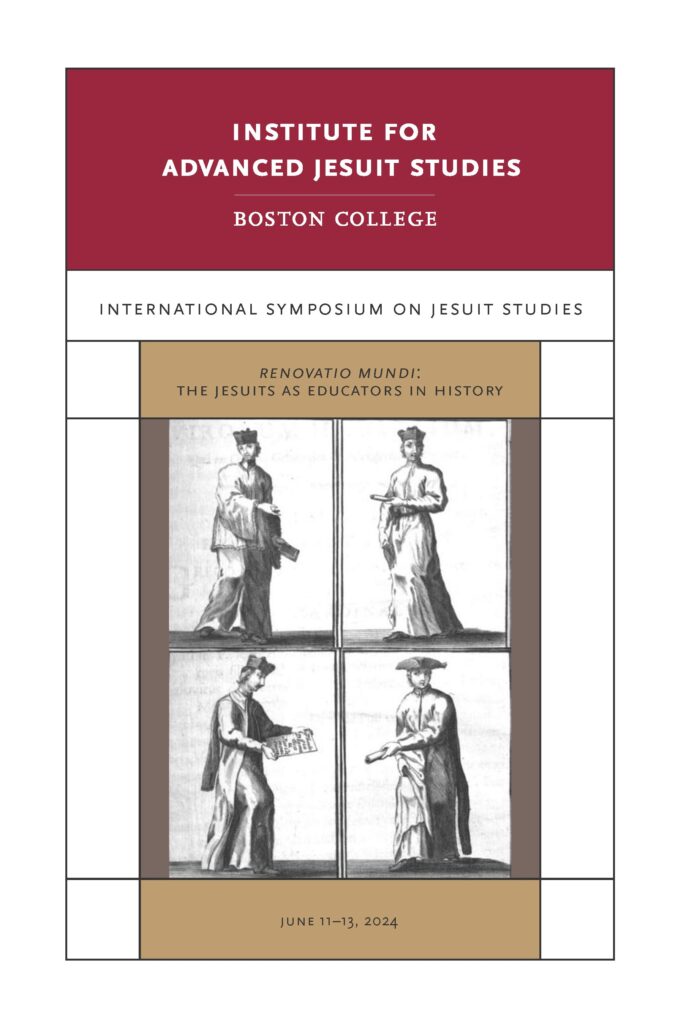
The volume brings together studies presented at the International Symposium on Jesuit Studies, Renovatio Mundi: The Jesuits as Educators in History, held at Boston College, Boston, June 11–13, 2024. It explores the history of Jesuit education from its early modern origins to the end of Pedro Arrupe’s generalate. Moving beyond conventional divisions between the Old and Restored Society and between geographical contexts, the contributions examine Jesuit education as a “living organism,” shaped by processes of continuity, adaptation, and experimentation.
Keywords:
Jesuits; Jesuit education; Ratio studiorum; Society of Jesus; higher education
Full Article
“Although in the present century there have been several impressive and scholarly volumes on the sources of Jesuit education published in this country [US] and in Europe, there is always need for starting anew the bases of a far-reaching system of educations.”[1]
With these words, Edward B. Rooney, S.J. (1900–76), President of the Jesuit Educational Association, introduced John W. Donohue’s Jesuit Education in 1963. The volume appeared at a moment of significant uncertainty for Jesuit education in the United States, as reflected, in particular, in the debates surrounding the Jesuit Educational Quarterly.[2] At the same time, Donohue’s work represented an important contribution to the renewed study of the Jesuit curriculum and its historical foundations.
Five years later, Gabriel Codina Mir’s Aux sources de la pédagogie des Jésuites would return attention to the formative role of the modus parisiensis,[3] while the publication of Ladislaus Lukács’s editions of the Ratio studiorum beginning in 1986 ushered in a new phase in the study of Jesuit education.[4] This scholarship contributed to a broader reassessment of the intellectual foundations of Jesuit pedagogy, particularly through a deeper appreciation of the humanist heritage embedded in the Society’s educational tradition, a perspective further developed in the work of scholars such as John W. O’Malley, S.J., and Paul F. Grendler.
It is not the purpose of this volume to reconstruct the extensive historiographical debate that has engaged scholars from a variety of disciplines from the 1990s to the present. Yet Rooney’s observation, formulated in response to the educational difficulties of his own time, remains strikingly relevant. The curricular challenges he confronted mirror, in important ways, those that prompted Robert Schwickerath, S.J. (1869–1948), to undertake the opening sentences of his monumental Jesuit Education at the beginning of the twentieth century.[5] They also resonate with questions confronting institutions of higher education in the contemporary Western world. Rooney’s call to “start anew” the foundations of a far-reaching system of education thus provided an apt starting point for the questions that guided the organization of the International Symposium on Jesuit Studies held at Boston College (Boston, June 11–13, 2024).[6]
Given the impressive scholarship produced over the past decades, is there still a need to “start anew” the foundations of Jesuit education? Can something genuinely new still be said about Jesuit education? And what new perspectives might emerge if we approach the history of the Jesuit curriculum not as a succession of separate experiences belonging to the Old and the Restored Society, but as a continuous process of elaboration, adaptation, and experimentation? Such an approach invites us to consider the persistent tension between the centralized conception of the educational model that emerges from sources produced at the Roman Curia, and the forms of local experimentation through which Jesuit education was continually adapted to different historical, cultural, and institutional circumstances.
Education has, in fact, occupied a central place in the apostolic life of the Society of Jesus since its foundation. What began as a response to the pastoral and intellectual needs of the early Society gradually developed into a vast and multifaceted educational apostolate, encompassing catechetical instruction, schools, colleges, universities, seminaries, and a wide range of other forms of intellectual and cultural formation. As the Society expanded across Europe and into the Americas, Asia, Africa, and other parts of the world, Jesuit education took shape within remarkably diverse political, social, cultural, and religious contexts.
However, the history of this apostolate cannot be reduced to the institutional continuity suggested by official documents and educational legislation. The concrete experience of Jesuit education was shaped by local circumstances, individual actors, institutional traditions, and changing historical conditions. Jesuit educators and their collaborators adapted methods, texts, curricula, and pedagogical practices to different environments. At the same time, students and local communities, in turn, helped shape the institutions in which they participated. The resulting history is therefore one of both continuity and adaptation, marked by significant differences across time and space.
This volume brings together studies that explore the development of the Society of Jesus’s educational apostolate from its early modern origins through the post-Suppression period to the end of Pedro Arrupe’s generalate (g. 1965–83). By adopting a broad chronological and geographical perspective, contributions seek to illuminate the complexity of Jesuit educational history beyond institutional narratives and normative prescriptions. Particular attention is devoted to the people who animated these institutions, including Jesuit educators, professors, students, collaborators, and other members of local communities, as well as to the networks of mobility that connected educational institutions across different regions.
The essays gathered here also examine the material and intellectual dimensions of Jesuit education: the methods and texts employed in classrooms, the organization of curricula, the formation and circulation of teachers and students, the intercultural exchange between East and West, and the everyday life of schools and colleges. Several contributions situate Jesuit educational institutions within their broader political, economic, and social environments, while others consider their relationships with local communities and the forms of cultural exchange arising from these encounters. Following up on the discussions that emerged in the 2023 International Symposium on Jesuit Studies Circa Missiones: Jesuit Understandings of Mission through the Centuries (Lisbon, June 12–14, 2023), particular consideration is given to educational experiences in mission territories, where local cultures could profoundly influence pedagogical practices, curricula, and forms of religious and cultural formation.
The volume also broadens the understanding of Jesuit education beyond the classroom. Faith formation, music, the arts, and physical activities constituted important dimensions of the educational experience and, particularly in missionary contexts, could provide significant spaces for interaction between Jesuits and local societies. Taken together, these studies demonstrate the plurality of practices, actors, institutions, and experiences that constituted the Jesuit educational apostolate over more than four centuries.
Rather than presenting a single, unified model of Jesuit education, the contributions to this volume reveal a constantly evolving field of practices shaped by the encounter between Jesuit educational ideals and the historical circumstances in which they were implemented.
The articles collected here aim to move beyond the conventional schematics of a periodization based on the distinction between the Old and the Restored Society, as well as beyond a strictly geographical approach. To use Rooney’s words, Jesuit education is understood here as a “living organism,” one that is continually evolving and “capable of growth and development.”[7] This perspective allows the contributions to be read not as separate episodes belonging to distinct historical periods or geographical contexts, but as different manifestations of a continuous process of reflection, adaptation, and experimentation.
For this reason, the volume is divided into two parts. The first focuses primarily on theoretical formulations that emerge from texts and reflections on education, including those that arose from the educational practice and experience of individual Jesuits. The second part turns more directly to the concrete experiences of educators and institutions, and seeks to identify underlying patterns of curriculum implementation and adaptation in different historical and cultural contexts.
Notes:
[1] Edward B. Rooney, S.J., introduction to Jesuit Education: An Essay on the Foundations of Its Idea, by John W. Donohue, S.J. (Fordham University Press, 1963), ix–xi, here x.
[2] A useful source for summarizing the landscape of the period is the June 1964 issue of Jesuit Educational Quarterly, which contains articles relating to that year’s JEA Annual Meeting. A clear analysis of the difficulties is offered in Joseph J. Feeney, S.J., “The 1964 High School Meetings: A Report,” Jesuit Educational Quarterly 27, no. 1 (1964): 36–42, here 37–38.
[3] Gabriel Codina Mir, S.J., Aux sources de la pédagogie des Jésuites: Le «Modus parisiensis» ( Institutum Historicum Societatis Iesu, 1968).
[4] Ladislaus Lukács S.J., ed., Monumenta paedagogica Societatis Iesu: Nova editio penitus retractata, vol. 5, Ratio atque institutio studiorum Societatis Iesu (1586, 1591, 1599) (Institutum Historicum Societatis Iesu, 1986) (= Monumenta paedagogica, nova editio, t. 5, MHSI 129).
[5] We are referring to the introduction to Robert Schwickerath, S.J., Jesuit Education: Its History and Principles Viewed in the Light of Modern Educational Problems (B. Herder, 1903), 1–16.
[6] Particularly significant in regard to Higher Education challenges nowadays was the roundtable discussion held during the final plenary session, “Past and Present: Jesuit Educational Institutions in the USA,” featuring William P. Leahy, S.J., Claude Pavur, S.J., Jeffery von Arx, S.J., and Michael Rizzi. The complete program of the Symposium is available at https://www.bc.edu/bc-web/centers/iajs/programs/international-symposia/2024—boston.html.
[7] Rooney, introduction to Jesuit Education, ix.
Metadata
Title: Introduction
Authors: Cristiano Casalini ; Alessandro Corsi ; A. Taiga Guterres
Article Type: Research Article
DOI: 10.51238/ISJS.2024.01
Language: English
Article number: e01
Pages: 1–5
Keywords: Jesuits; Jesuit education; Ratio studiorum; Society of Jesus; higher education
Volume: 4
Issue: 1, special issue
In: Renovatio Mundi: The Jesuits as Educators in History
Editors: Cristiano Casalini ; Alessandro Corsi ; A. Taiga Guterres
In: International Symposia on Jesuit Studies
Publication Date: 30 October 2026
Last Updated: 30 October 2026
Publisher: Institute of Jesuit Sources
E-ISSN: 2766-0644
ISBN: 979-8-90493-018-9
Cite
APA
Casalini, C., Corsi, A., & Guterres, A. T. (2026). Introduction. In C. Casalini, A. Corsi, & A. T. Guterres (Eds.), Renovatio mundi: The Jesuits as educators in history (Proceedings of the symposium held at Boston College, June 11–13, 2024) [Special issue]. International Symposia on Jesuit Studies, 4(1), Article e01. https://doi.org/10.51238/ISJS.2024.01
CMOS
Casalini, Cristiano, Alessandro Corsi, and A. Taiga Guterres. “Introduction.” In “Renovatio Mundi: The Jesuits as Educators in History (Proceedings of the Symposium held at Boston College, June 11–13, 2024),” ed. Cristiano Casalini, Alessandro Corsi, and A. Taiga Guterres, special issue, International Symposia on Jesuit Studies 4, no. 1 (2026): e01. https://doi.org/10.51238/ISJS.2024.01.
MLA
Casalini, Cristiano, Alessandro Corsi, and A. Taiga Guterres. “Introduction.” Renovatio Mundi: The Jesuits as Educators in History (Proceedings of the Symposium held at Boston College, June 11–13, 2024), edited by Cristiano Casalini, Alessandro Corsi, and A. Taiga Guterres, special issue of International Symposia on Jesuit Studies, vol. 4, no. 1, 2026, article e01. https://doi.org/10.51238/ISJS.2024.01.