



Di, Wu. “Comparisons between the Manuscript from José Monteiro and the Surviving Documents in Chinese and Other European Languages.” In “Circa Missiones: Jesuit Understandings of Mission through the Centuries (Proceedings of the Symposium held at Lisbon, Portugal, June 12–14, 2023),” ed. Alessandro Corsi, Claudio Ferlan, and Francisco Malta Romeiras, special issue, International Symposia on Jesuit Studies 3, no. 1 (2026): 1–25. https://doi.org/10.51238/ISJS.2023.14.
 Open Access
Full Article
Metadata
Cite
Full Article
Introduction
The pioneers of Catholic evangelization in early modern China, the Jesuits, developed a language policy similar to their missions worldwide, which involved mastering the local languages. Even before the Chinese mission began in 1582, the Jesuits opted to learn the universal language of the imperial bureaucracy, guanhua (known as Mandarin by the Portuguese). In contrast, mendicant missionaries in the Philippines chose to learn the Minnan language, prevalent among overseas Chinese communities, to cater to their predominantly Minnan-speaking audience. Unlike the mendicant missionaries’ focus on orality, the Jesuits in China dedicated themselves to studying the writing system, reflecting their commitment to engaging with the literate elites.
The notion of learning Chinese as part of the mission began with St. Francis Xavier (1506–52), but it was Alessandro Valignano (1539–1606) who established the principle of cultural accommodation.[1] The first step to accomplish their mission was the daunting task of learning Chinese. Acquiring what one Jesuit manuscript describes as the “very difficult by nature”[2] language was critical to overcome the significant cultural and linguistic barriers the missionaries faced, particularly given the challenges posed by the logographic nature of Chinese. This fundamental difference between Chinese and European languages made mastering Chinese characters exceedingly difficult for missionaries.
Acknowledging these challenges, Michele Ruggieri (1543–1607) and Matteo Ricci (1552–1610) were the first Jesuits to implement this strategy. Ruggieri followed Valignano’s directive, traveling to Macau to study the language. In 1582, Ricci arrived in Macau and, with Ruggieri’ s help, began to become acquainted with the language.[3]
By September 1583, the duo had moved to Zhaoqing, where their linguistic skills and integration of local customs helped them gain acceptance by local authorities, thus advancing their mission. Their impressive skills are evident in their works, including Ruggieri’s Tianzhu Shilu 天主实录 (The true account of the Lord of Heaven)[4] and Ricci’s Tianzhu Shiyi 天主实义 (The true meaning of the Lord of Heaven),[5] which showcase their considerable language proficiency. Notably, these two Jesuits translated various Christian terms in their works, which sparked numerous debates regarding the names of God. This highlights the efforts and challenges faced by the first generation of Jesuits as they endeavored to learn Chinese and contribute to their missionary work. The following sections provide further details about these names, along with other terms presented in the documents we are comparing.
A pattern emerged for learning Chinese among the Jesuits whereby an experienced Jesuit would mentor their newly arrived confrère, exemplified by Ruggieri’s mentorship of Ricci. To facilitate their studies, they hired a Chinese teacher who used the Four Books and other Confucian classics to help them learn characters, while Portuguese or Latin was used to note meanings and pronunciations.[6] To formalize and systematize these linguistic and cultural efforts, the Jesuits, under the guidance of Manuel Dias Sénior (1559–1639), established a Ratio studiorum (Plan of studies) for the China vice-province in 1624. The Ratio proposed a period of study spread over four years of a rigorous framework for language training and cultural immersion.[7]
However, the missionaries’ acquisition of Chinese evolved over time. As Christian communities expanded—particularly after decades of engagement shaped by the Ratio studiorum—missionaries faced increasing pressure to adapt their linguistic strategies to meet the demands of communication and instruction in a complex and unfamiliar language. This pressure was exacerbated by societal upheaval caused by the Manchu and difficulties in the late Ming court, which disrupted consistent, systematic language study. Consequently, there was a demand for a more practical and efficient method of language learning.[8]
Jesuit José Monteiro’s manuscript serves as a noteworthy illustration of one such change. It offers a condensed method of study, likely devised in response to the limited time available to missionaries due to their increasing pastoral and administrative duties. This concise manual appears to have been intended for fellow missionaries beginning their Mandarin studies. Rather than replacing existing reading requirements, it functioned as an introductory tool designed to ease their entry into the language before progressing to more advanced materials.
This paper looks at Monteiro’s manuscript alongside other materials to answer some key questions. It explores how earlier resources were reused, how the missionaries adapted their methods to fit new challenges, and how they adjusted their approach to meet the needs of their era. It also examines how Jesuit and non-Jesuit missionaries worked together, sharing and exchanging educational materials to learn and teach the Chinese language. To do this, I compare Monteiro’s manuscript with four surviving documents:
– “Pin cuì ven tà ssi gni” (宾主问答辞义 Bin zhu wen da ci yi) (The meanings of words and phrases for questions and answers between a guest and a host)[9]
– “拜客问答” (Bai ke wen da) (Answers to visitors’ queries)[10] (Bibliothèque Nationale de France [BnF], manuscript chinois 7024)
– “圣教要紧的道礼” (Shengjiao yaojin de daoli) (The essential principles of the holy teaching)[11] (BnF, manuscript chinois 7046)
– “拜客训示” (Bai ke xun shi) (Instruction for the visits of mandarins)[12] (Archivo Histórico de la Provincia de Toledo de la Compañía de Jesús, Caja 101, China [II], no. 33, Lg. 1042.14)
In addition to these four manuscripts, I will also compare Monteiro’s manuscript with two others, as well as another manuscript (attached to Arte de la lengua Mandarina of Francisco Varo) of a different nature:
– Grammatica linguæ Sinensis of Martino Martini
– Arte de la lengua Mandarina of Francisco Varo
– The manual of confession of Basilio Brollo de Glemona
Before going on to compare Monteiro’s manuscript, “Vera et unica praxis breviter ediscendi, ac expeditissime loquendi sinicum idioma suapte natura adeo difficile” (hereafter “Praxis”) with other manuscripts, here is some brief biographical information about José Monteiro. He was born in Lisbon around 1646. In 1677, he embarked on a journey to Asia. He arrived in mainland China in early 1680 and served as the vice-provincial of China on two occasions, spanning the late seventeenth and early eighteenth centuries. He passed away in Macau in 1720. He ventured through various regions, each characterized by distinct Chinese languages that likely impacted his approach to romanization[13] and the expressions employed in Mandarin within his manuscript.
“Praxis,” composed around 1700, consists of seventy-nine folios and provides an overview of the language and vocabulary for newly arrived missionaries to learn Chinese. Written in Portuguese, it encompasses romanized Chinese supplemented with Latin. The contents of the manuscript include a brief grammar outlining the fundamental principles of the Chinese language, various vocabulary lists, a dialogue, and a manual of confession.
Comparisons between “Praxis” and Other Documents in Chinese (Romanized or in Chinese Characters)
1. “Pin cuì ven tà ssi gni” (宾主问答辞义 Bin zhu wen da ci yi) (The meanings of words and phrases for questions and answers between a guest and a host) (hereafter referred to as the Manuscript from Archivum Romanum Societatis Iesu and abbreviated as MS.ARSI)
The first manuscript, titled “Pin cuì ven tà ssi gni” (宾主问答辞义 Bin zhu wen da ci yi) and taking the form of a dialogue, was discovered by Pasquale d’Elia at the beginning of the Portuguese–Chinese Dictionary, written in romanized Chinese. It was likely authored by Ruggieri around 1585.[14] The dialogue comprises a conversation between a priest (the host) and a Chinese literatus or an official (the visitor). Topics covered include family, missionary life, clothing, religious matters (such as God, religious customs, fasting, and the Ten Commandments), as well as the differences between Buddhism and Catholicism.
The dialogue under scrutiny incorporated terms associated with Buddhism, a stark departure from Monteiro’s manuscript. Examples include “小僧” (xiao seng), signifying a young monk imbued with humility, and “敝徒” (bi tu), denoting self-identification as a humble disciple, along with “师父 寺” (si), referring to a temple. Additionally, the term “师父” (shi fu) was used by the visitor to address the host, which translates to “master” in Chinese and could denote a monk or spiritual teacher in a Buddhist context. These terms suggest that this dialogue likely emerged or circulated during the initial stages of the Jesuits’ arrival in China as the locals tried to integrate their foreign concepts into pre-established social norms.
Initially drawing from their successful experiences in Japan, Jesuits attempted to emulate bonzes/monks “和尚” (heshang) to resonate with the Chinese populace. They believed that aligning themselves with Buddhist practices would be effective because they thought the Chinese were primarily Buddhists. They also shared the idea that Ruggieri engaged in creating this dialogue, as he incorporated Buddhist concepts to better connect with the local people. He even referred to himself as a monk “僧” (seng) and adopted terminology from Buddhism in his interactions, aiming to resonate with the primarily Buddhist Chinese community.
Monteiro’s manuscript, “Praxis,” in contrast, eschews Buddhist-related nomenclature in favor of terminology more aligned with Christian concepts—for instance, “神父” (shenfu), translating to “priest” or “spiritual father,” and “天主堂 老爷” (laoye), a respectful term for “sir” or “venerable sir.” Similarly, ““天主堂” (Tianzhu Tang), meaning “church,” replaces the earlier Buddhist term.
The table below shows the differences between these two manuscripts.
MS.ARSI |
| “Praxis” | |
“小僧” (xiao seng): a young 敝徒 monk; “ ” (bi tu): calling himself a humble disciple | “师父” (shi fu): Buddhist master | “神父” (shenfu): priest | “老爷” (laoye): lord/sir |
“寺” (si): temple |
| “天主堂” (Tianzhu Tang): church | |
Table 1. Forms of Address and Related Terms in MS.ARSI and “Praxis”
The comparison in table 1 shows the changes between the two manuscripts, highlighting the shift from Buddhist-influenced terms to those that are more Christian. Through words like “老爷” (laoye) and “天主堂” (Tianzhu Tang), it becomes evident that
Jesuits began seeking connections between Christianity and indigenous philosophical thought, such as Confucianism. However, this transition did not occur abruptly. Rather, it went through a long journey that involved choosing the more suitable names that would facilitate their missionary work to help the Chinese people accept Christianity.
How, then, did the fi rst-generation Jesuits navigate the transition from Buddhist to Confucian terms and ultimately to more Christian terminology? Further comparison with the “Praxis” and other Chinese documents may help clarify this evolution. This linguistic shift not only refl ects changes in terminology but also indicates a strategic transformation in the Jesuits’ engagement with the Chinese population, revealing how their strategies aligned with contemporary needs and local customs.
2. “拜客问答” (Bai ke wen da) (Answers to visitors’ queries) (hereafter referred to as Anonymous Chinese Manuscript 1 and abbreviated as MS.ACh1)
The anonymous manuscript written in Chinese characters titled “Bai ke wen da 拜客问答” lacks an attributed author and date. However, clues within the dialogues that refer to a priest who had resided in China for twenty years and held a position at the court “ 朝廷” (chaoting) in Beijing suggest a possible connection to Ricci. This manuscript recounts the experiences of a newly arrived missionary in China and explores various aspects of missionary life, religion, fasting, and travel. It features vivid dialogues between a Chinese visitor, likely an intellectual or official, and a European priest. For example:
Question: Did you also see any strange creatures at sea?
Answer: We often saw sea monsters. There were large fish as big as a house. These sea fish had a large eye on their heads and often spouted water a zhang[15][about three meters] high.[16]
Another dialogue touches on examinations in Europe:
Question: What books do you read for the examinations?
Answer: The first is the Genesis. The rest are the Gospels (books of the sages).
Question: Who are these sages? Are they the sage Confucius from my region?
Answer: Each place has its own sages. In our area, for the past two thousand years, there have been sages in every generation who have written excellent books, and this continues to be true even today.[17]
We can see here that some of the names had changed again: in Monteiro’s dialogue, the terms “padre” (priest) and “Christão” (Christian) are consistently used when conversing. However, within the dialogue itself, the romanized Chinese counterparts representing the priest are referred to as ““老爷” (laoye) or “老师” (laoshi), which mean “lord” or “professor,” and Christians are referred to as “相公” (xianggong), “教友” (jiaoyou), or “门生” (mensheng), which respectively mean “gentleman,” “Christian,” or “student.” But MS.ACh1 uses “西士” (xishi) (Western scholar) and “中士” (zhongshi) (Chinese scholar) to represent the priest and the visitor respectively. From the table below, we can see this gradually changing, from MS.ARSI to MS.ACh1 and Monteiro’s manuscript.
“Praxis” |
| MS.ARSI |
| MS.ACh1 | |
Priest | Christian | Priest | Visitor | Priest/host | Christian/ visitor |
|
| “小僧” (xiao seng): a young monk; “敝徒” (bi tu): calling himself a humble disciple | “宗师” (zong shi): master | “西士西国人士” (xi-shi)/ “ ” (xi-guo renshi): Western scholar | “中士[18] ” (zhong-中国 shi) / “ 人士” (zhong- guo renshi): Chinese confucianist |
“老爷” (laoye): lord | “相公” (xianggong): gentleman; “教友” (jiaoyou): Christian |
| “老爷” (laoye) “相公” (xianggong) | “老爷相公” (laoye) “ ” (xiang- gong) | “相公” (xianggong) |
“老师” (laoshi): professor | “门生” (mensheng): student | “师父” (shi fu): Buddhist master | “先生” (xiansheng): sir | “老先生” (lao xiansheng): venerable sir/ professor | “学生” (xuesheng): student |
|
|
| “主人” (zhu ren): host | “客人” (ke ren): visitor | |
Table 2. Forms of Address and Related Terms among the “Praxis,” MS.ARSI, and MS.ACh1
The evolution of terms used to refer to religious figures, as seen in table 2, shows how the missionaries adapted the language to fit China’s cultural context. The Buddhist-influenced terms mentioned in MS.ARSI, “小僧” (xiao seng), meaning “a young monk,” and “敝徒” (bi tu), which is a way to call himself “a humble disciple,” were gradually replaced by ““中士” (zhongshi) for “Chinese Confucianist” and “西士” (xi shi) for “Western Confucianist/scholar,” both of which align more closely with Confucian traditions. Ultimately, this progression culminated in the adoption of the Christian term “教友” (jiao you) as “Christian” in Monteiro’s manuscript.
As previously noted, Ruggieri engaged with Buddhism to facilitate his missionary work. Similarly, Ricci’s efforts and strategies were evident when he befriended literati and spoke to local officials in Shaozhou, discovering that Confucianism was more effective with them.[19] He soon realized the limitations of the Buddhist approach, given the low social status of Buddhist monks in Chinese society at that time, and adjusted the cultural accommodation strategy to align more closely with the literati and officials, who held higher societal standing or were in closer proximity to the emperor. Notably, Ricci abandoned the monk’s robe on his journey to Beijing and began identifying as a “西士” (xi shi), a “Western scholar,” rather than a monk.
Ricci used the term “上帝” (Shangdi), meaning “Sovereign on High,” to represent God within a Confucian framework as part of his missionary strategy. This term has been used in Chinese language and culture since ancient times. Ricci aimed to convince the Chinese that embracing Christianity would restore the original principles of Confucianism, free from the influences of Buddhism, Taoism, and neo-Confucianism.[20] However, this approach sparked controversy, as critics argued that using “上帝” (Shangdi) in translation risked undermining the true essence of Christianity. They pointed out that its complex meanings in Confucianism included more than just the idea of the “Most High” and also involved political connections to emperors.
On the other hand, the term “天主” (Tianzhu), meaning “Lord of Heaven,” was coined by the Jesuit missionary Michele Ruggieri as the initial Chinese translation for God. While it may not be directly linked to traditional Chinese culture, it connected to localized Buddhism. More importantly, it avoided confusion among Chinese Christians who accepted “上帝” (Shangdi) as “Deus.” It also helped prevent debates among those opposing this name for God both within the Jesuit order and among the Chinese literati at that time.[21]
That may explain the absence of the term “上帝” (Shangdi) in “Praxis” and the two other documents. Instead, terms such as “天主” (Tianzhu), “吾主” (Wuzhu) (my Master of Heaven), and “天地的主宰” (Tiandi de Zhuzai) (Sovereign of Heaven and Earth) are used. This suggests that these texts featuring the term “天主” (Tianzhu) circulated more widely. This choice of names indicates a deliberate effort to avoid controversy and facilitate a clearer understanding for missionaries while helping the Chinese people distinguish Christianity from other religions in China.
In addition to the terminology used for the terms in Christianity, there are notable differences in the translated names of countries. For example, in MS.ACh1, the priest mentions Europe using expressions such as “歐羅巴” (Ou luo ba) and “大西洋” (Da xi yang)—the Great Atlantic—whereas in Monteiro’s manuscript, the priest specifies that he hails from the “Reyno de Lusitania” (Kingdom of Lusitania).
This comparison illustrates that the “Praxis” is more practical regarding the dialogues it contains. Both MS.ACh1 and Monteiro’s manuscript depict analogous scenes wherein a Chinese literatus or official presents an invitation card “拜帖” (bai tie) to visit a Jesuit or priest. In MS.ACh1, following the delivery of the invitation card, a polite conversation ensues, during which the Chinese visitor’s curiosity about the Europeans emerges.[22] While Monteiro’s manuscript lacks an identical scene, it includes a dialogue between the priest and the Chinese Christian that contains similar phrases and information, particularly regarding expressions of courtesy. Those expressions are more practical and beneficial for newly arrived missionaries, enabling them to learn the Chinese language quickly and effectively engage in their missionary work.
The emphasis on humble adherence to etiquette remains evident. For example, the dialogues always begin with “请” (qing), signifying “please.” Additionally, the language employs honorifics to describe others, such as referring to another’s country as “贵国” (gui guo), which translates to “your esteemed country.” This practice similarly extends to references to another’s city, or residence, articulated as “贵府” (gui fu).
Overall, the terminology used in MS.ARSI and MS.ACh1 reflects Buddhist influences and Confucianism respectively, while Monteiro’s manuscript aligns more closely with Christian terms. This shift in language minimized confusion for Chinese audiences and reduced the potential for disputes among missionaries. In addition to transitioning from more formal written Chinese to a more colloquial style in Monteiro’s manuscript, the dialogue format and etiquette were preserved, making it practical for conversations. Meanwhile, the Jesuits built upon the materials of their predecessors, adapting their language based on local acceptance to communicate effectively and minimize misunderstandings.
3. “圣教要紧的道礼” (Shengjiao yaojin de daoli) (The essential principles of the holy teaching) (hereafter referred to as Anonymous Chinese Manuscript 2 and abbreviated as MS.ACh2)
This Chinese manuscript, called “圣教要紧的道礼” (Shengjiao Yaojin de daoli), belonging to the National Library of France, is unsigned, and the date and place of writing are also unknown.
This paper compares the first part of the manuscript, concerning Catholicism, with Monteiro’s manuscript. There are four corresponding parts in both documents. They are “Dialogues with a Newly Arrived Priest,” “About God,” “Matters Related to Religious Devotion,” and “Principles of Each Confession Commandment.”
“Praxis” | “Shengjiao Yaojin de daoli”/MS.ACh2 |
“Vizita com hum Christão” (Visit with a Christian) fols. 11–16 | “Dialogue with a Newly Arrived Priest” 新來神父拜客問答, fols. 33–37 |
“Deos” (God) fols. 17–23 | “About God” 天主的行述, fols. 24–29 |
“Christão, e suas obrigações” (Christian, and His Obligations) fl s. 26-30 | “ Matters Related to Religious Devotion” 奉教的事情, fols. 30–33 |
“Começa o Confi ssionario pelos des Mandamentos” (The manual of confession) (Begin the Confession from the Ten Commandments) fols. 61–79 | “Principles of Each Confession Commandment” 一誡一誡告解的道禮, fols. 5–20 |
Table 3. Structural Correspondence between the “Praxis” and MS.ACh2
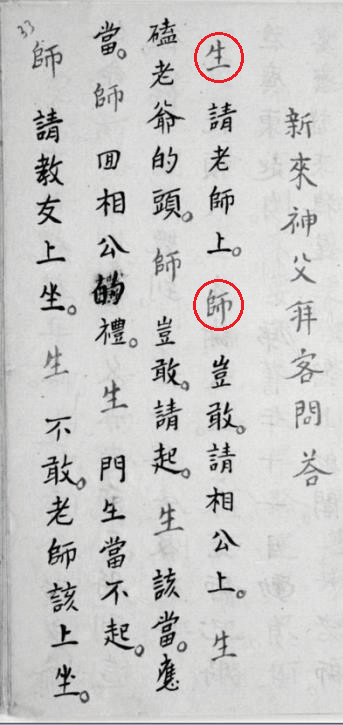
First, “Vizita com hum Christão” (Visit with a Christian) (Monteiro: fol. 12) consists of a dialogue between a priest and a Christian. We have two identical dialogues between a European priest who asks the questions and a Chinese Christian who answers them. I n both dialogues, the priest is clearly depicted as superior to the Chinese Christian, since the former appears as the older man or master, and the latter as the younger man or student. In other words, the choices made in the two documents implicitly reflect the Confucian hierarchical relations of respect for elders and teachers (see figure 1) and thus do nothing to alter the meaning of the texts.
One of the slight differences is that the term “father,” which Monteiro translates as “老爷” (laoye), is referred to in MS.ACh2 as “師” (shi) (teacher/master—now “老师” [laoshi], another extremely respectful form). The Christian, referred to by Monteiro as “相公” (xianggong) (gentleman), appears as “生” (sheng) (student) in MS.ACh2.
MS.ACh2 (vol. 1, fol. 33)
| “Praxis” of Monteiro (c.1700, fol. 12) Christão = convido o Padre pera sima = Çim lao ye xam […] Padre = Não me atrevo; Vossa mercê suba pera sima = ki can, cim siam cum xam Lao ye “老爷”(laoye):sir siam cum “相公” (xianggong):gentleman
|
Figure 1. Comparison between MS.ACh2, fol. 33r and “Praxis,” fol. 12
In the documents, we can see a dialogue about the priest’s route, which is the same in both texts: they left Canton for Ganzhou, where they stayed for eight days; from there, they continued to Nanchang (noting that they did not go via Tingzhou but rather Jianchang). They then sailed for a month to the place they were discussing, which seems to correspond to a district of Lianjiang, in the city of Fuzhou (Fujian province).[23] Thus, in Monteiro’s manuscript, we can read:
Christão = O Padre quando partiu de Cantão [?]
[Christian: Father, when did you depart from Canton?]
[…]
Christão = O Padre em Cancheu esteve quantos dias [?] [Christian: Father, how many days did you stay in Canton?] Padre = estive 8 dias = chu leao pa tien.
[Priest: I stayed for eight days.]
Christão = O Padre andou pello caminho de Tim cheu [?]
[Christian: Father, did you take the road to Tingzhou?]
Padre = Não fiz este caminho [Priest: I didn’t take this road.] Christão = que caminho fez [?]
[Christian: Which way did you take?]|
Padre = De Cancheu a Nan cham, de Nan cham por Kien cham cheguei aqui
[Priest: I arrived here, from Ganzhou to Nanchang, from Nanchang through Jianchang.]
[…]
Christão = O Padre quando partio de Nan cham [?]
[Christian: Father, when did you depart from Nanchang?]
Padre = A lua passada aos 8 parti (vide Mapa 1)
[Priest = I departed on the 8th of last month.]
The dialogue depicted in Monteiro’s “Praxis” and in MS.ACh2 follows the same route, represented by the dashed line on Map 1. The blue line corresponds to the biography of Monteiro. If the blue line is accurate (which is more likely), then the orange line does not represent Monteiro’s actual route. In other words, the content served as a model for dialogue, and Monteiro adapted it based on the city he passed through, Jianchang instead of Tingzhou, from Nanchang to Fuzhou.
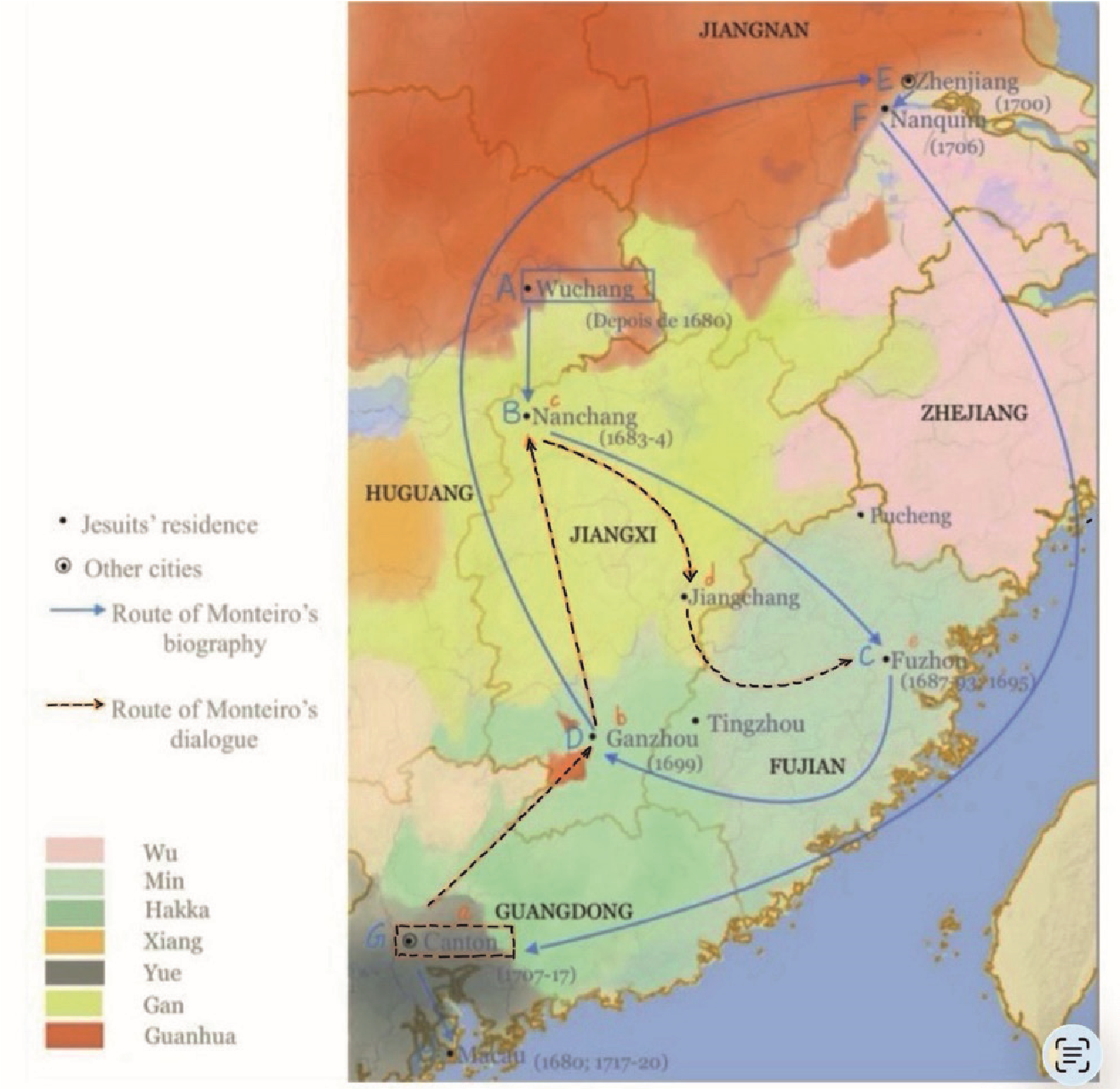
Map 1. Routes of José Monteiro
In the following dialogue, the Christian interrogates the priest about his country of origin. Here, we find an interesting difference: while Monteiro, in “Praxis,” indicates the “Reyno de Lusitania”[24] (Kingdom of Lusitania), MS.ACh2 leaves the country undefined as “某国” (mouguo, “a certain country”).[25] This lack of specificity leads us to question whether this could be a model dialogue, subject to slight adaptations for each specific case depending on the missionary’s origin.
Second, the part labeled “Deos” (God) (Monteiro: fol. 17) exhibits substantial congruence in both “Praxis” and MS.Ach2, characterized by minimal disparities in characters or punctuation yet maintaining semantic equivalence. For instance, while Monteiro’s manuscript translates the term “eternal” as “常在” (changzai), denoting “always being,” MS.ACh2 employs the characters “不死” (bu si), signifying “not dying.” In fact, neither translation directly expresses the concept of “eternal” as the more literal Chinese term “恒” (heng). Instead, both translations reflect a deliberate choice by the missionaries to use more accessible language that would be more easily understood by their audience.
Consistency is observed for terms such as “Father,” “Holy Spirit,” and “Son” in both documents: “罷德勒” (Ba de le), “斯被利多” (Si bei li duo), and “费略” (Fei lüe), respectively. The text “Deos,” which contains these transliterations, appears to have been composed earlier or relies on earlier linguistic resources, reflecting an initial phase of linguistic accommodation where phonetic renditions were employed.[26] This approach gradually evolved as the Jesuits adjusted their strategies to better align with Chinese linguistic and cultural contexts. This evolution is evident in the transition from transliterations to more culturally resonant translations, such as the use of “神父” (Shenfu), combining “Shen” for spirit and “fu” for father, in the previous and later dialogues. Monteiro further embraced this cultural accommodation by adopting terminology rooted in associative meanings developed by earlier missionaries. For example, “神父” (Shenfu, “priest”) for father and “圣神” (Shengshen)[27] for the Holy Spirit demonstrate an integration of native linguistic elements. Additionally, “Maria” was translated as “圣母” (Shengmu), which literally means “Holy Mother” instead of the transliteral version “玛丽亚” (Ma Liya).
These adaptations illustrate the ongoing Jesuit commitment to cultural accommodation as they refined their linguistic adaptations to better communicate their religious concepts in a culturally relevant manner, ensuring the continuity of their mission in a way that resonated more deeply with the local population.
Third, the section titled “Christão, e suas obrigações” (Christian, and his obligations) (Monteiro: fol. 26) exhibits correspondence with MS.ACh2. Notably, within this analogous segment, three small circles frequently appear, symbolized as “。。。,” in MS.ACh2. This symbol could have been used to separate the content from the preceding subsection or to indicate omitted material. Alternatively, it may reflect copying from other (non-Chinese) missionary manuscripts in which an ellipsis “[…]” was used, the symbol being rendered in Chinese copying as three dots “[。。。].” Since traditional Chinese writing did not employ a standardized ellipsis mark, the precise function of this sign remains uncertain.
Interestingly, the text “About God” in MS.ACh2 includes a transliteration of “Cristão” (Christian) as “契利斯当” (Qi li si dang), whereas this section of dialogue in Monteiro’s manuscript omits the transliteration. This choice may reflect an intention to simplify the explanation of “Cristão,” opting instead for “教友” (jiaoyou) (Christian), which is more readily understood by Chinese speakers. This adaptation not only enhances comprehension for the local populace but also provides a more practical term for missionaries to use in their missionary work.
Last but not least, the confession manual within MS.ACh2 mirrors that of “Praxis,” featuring only minor discrepancies in punctuation and sentence breaks. The translated title of MS.ACh2’s confession manual can be rendered as “Principles of Each Confession Commandment.” The presentation of the Ten Commandments assumes a dialogue format, except for the First Commandment, which is articulated in the form of a response. The titles of each commandment are methodically listed under distinct subheadings, as visually depicted in the accompanying image:
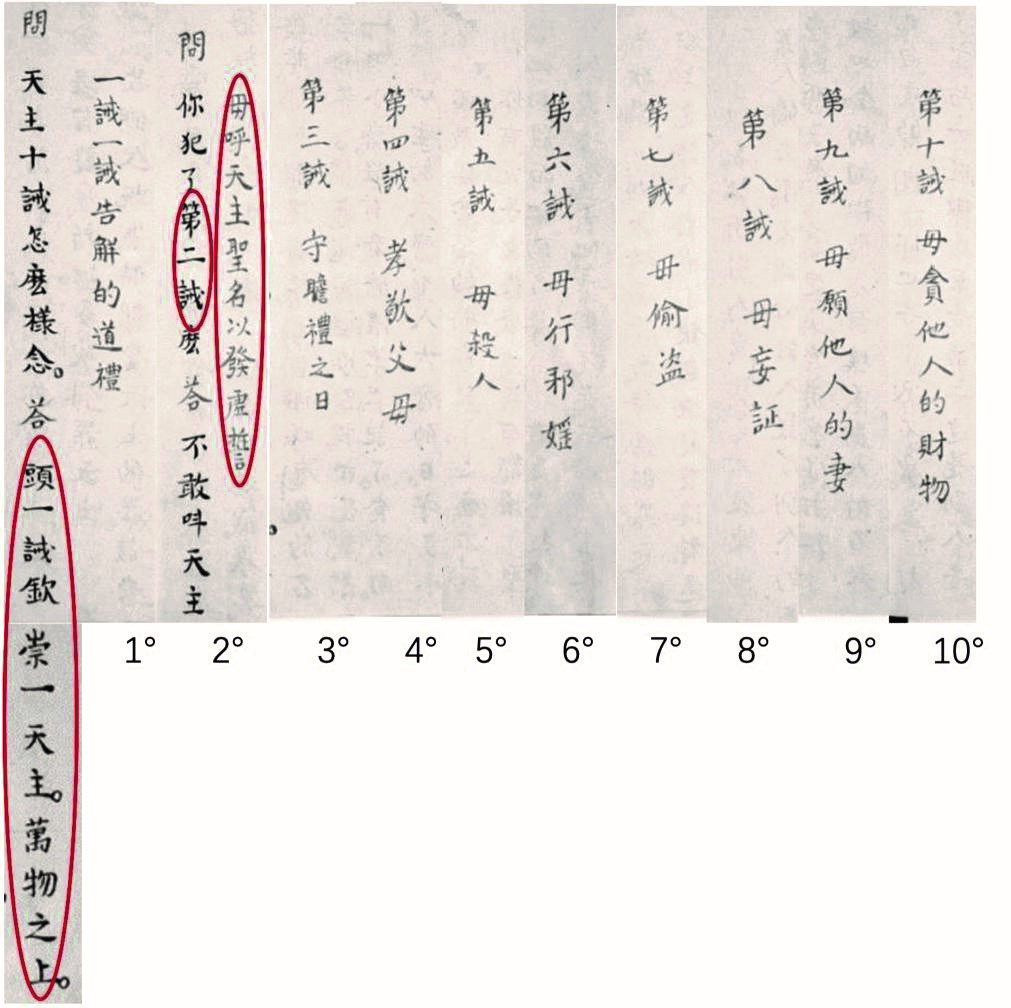
Figure 2. The Titles of Each Commandment from MS.ACh2, fols. 5r–18v
The sequencing of the text in the manuscript follows the top-to-bottom and right-to-left convention, evident in the title of the First Commandment spanning from the end of folio 5 to the beginning of folio 6. However, for ease of comprehension, the text is presented here in a left-to-right direction. Content-wise, disparities are minimal, primarily observed between the Sixth and Ninth Commandments, with MS.ACh2 displaying a more concise rendition compared to Monteiro’s manuscript.[28]
There are some noteworthy character errors in MS.ACh2, where certain characters are mistakenly interchanged as homophones or homographs, at times representing mere variants.[29] As highlighted by Liam Brockey and Adrian Dudink,[30] instances of confusion, such as “理” (li) (reason/logic) and ““禮” (li) (courtesy), are evident. For instance, the intended inclusion of the character “理” in the principles of Christianity is erroneously rendered as “禮.” While such errors do not compromise the clarity of the text, they suggest that MS.ACh2 was likely prepared by missionaries in the process of learning to write in Chinese.
A comparative analysis with Monteiro’s manuscript underscores substantial content identity, affirming the missionaries’ reliance on copying and translation methodologies in their language acquisition, reminiscent of their practices when studying languages like Latin. However, they gradually adapted these practices to suit the Chinese cultural context, particularly in translating Christian terminology into Chinese and modifying their writing style to diverge from European conventions. This evolution reflects their understanding of the need to engage meaningfully with Chinese culture and language.
4. “拜客训示” (Bai ke xun shi) (Instruction for the visits of mandarins) (hereafter referred to as the Chinese Manuscript of Toledo and abbreviated as MS.ChT or Toledo manuscript)
Next, the manuscript from Archivo Histórico de la Provincia de Toledo de la Compañía de Jesús constitutes an important discovery primarily characterized by its use of Chinese characters, supplemented by a limited amount of romanization and a few French translations. Unattributed to any specific author or date, this manuscript, identified by Lee Yuchung in 2015,[31] diverges from the structure of “Praxis” but contains eight dialogues on different topics. Among these dialogues is “拜客问答” (Bai ke wen da) (the same as MS.ACh1, the second manuscript compared). The other seven thematic dialogues include “管堂中事” (Matters in church); “厨房的事” (Matters in the kitchen); “买办的事” (Buyer’s affairs); “衣服帽房的事 库房的事” (Matters in pantry); “看门的事茶房的事” (Matters in tea house); “ ” (Matters in wardrobe); “ ” (Matters about gatekeeper); “行水路船工的事” (Matters about boatman when traveling by waterway). While “Praxis” lacks such dialogues, thematic overlaps exist between the dialogues in the Toledo manuscript and the vocabulary lists featured in the “Praxis.” For example, the theme of “管堂中事” (Matters in the church) in the Toledo manuscript corresponds to the vocabulary list concerning “Igreja, sacristia, e suas couzas” (Church, sacristy, and their things) and “Christão, e suas obrigações” (Christian and their obligations) found in “Praxis.” Additionally, topics related to daily life such as kitchen, tea, food, travel, and clothing are explored in both manuscripts.
Moreover, specific phrases presented in the question-and-answer session of the Toledo manuscript, for instance “this morning on the fourth stroke, I went to the courthouse to repair the bell,” are reflected as individual vocabulary entries within Monteiro’s manuscript under the section titled “Tempo, ano, mês, dias e houras” (Time, year, month, days, and hours). They are presented as “this morning” and “on the fourth stroke”[32] (Monteiro, fol. 8). Etiquette expressions found in the Toledo manuscript’s dialogues, including terms like “homenagem” (homage), “vossa mercê” (your mercy), “seu reino” (your kingdom), and “sua província” (your province), similarly appear both individually as vocabulary items and within the dialogue section “Vizita com hum Christão” (Visit with a Christian) in Monteiro’s “Praxis” (Monteiro, fol. 12).
An interesting example illustrating this difference in format is found in the section “茶房的事” (Matters in tea house) from the Toledo manuscript, which depicts a probable interaction between a missionary and a Chinese servant regarding serving tea and snacks to distinguished guests:
Tea and snacks should also be divided into two categories: if guests of high status arrive, they should be served pine nuts, hazelnuts, almonds, and melon seeds. If ordinary guests come, they should be served grapes, ginkgo nuts, roasted beans, lotus seeds, jujubes, and chestnuts.
While the Toledo manuscript presents these snacks within detailed conversational scenarios, Monteiro’s manuscript includes some of the same items, such as pine nuts and chestnuts, under the section “Lavrador, e lavoura” (Farmer and farming). Additionally, Monteiro lists fruits exclusive to southern Chinese regions, especially around Canton, such as “Lichias = li chi; Longans = lum yen” (litchi, logan) (Monteiro: fol. 57). This again highlights the structural difference: the Toledo manuscript consistently uses dialogues, whereas Monteiro organizes vocabulary into discrete thematic categories. Although explicit structural parallels are lacking, the common presence of certain key terms and phrases suggests both manuscripts drew upon a broader shared pool of linguistic resources. Furthermore, the inclusion of region-specific fruits like litchis and longans indicates that these manuscripts, or the resources upon which they were based, likely circulated among missionaries operating in different Chinese regions— an assumption requiring further verification.
The incorporation of these dialogues covering daily life topics is a consistent feature in both manuscripts, underscoring their importance in language learning. The vocabularies in Monteiro’s manuscript likely functioned as a glossary intended for missionaries preparing to engage in more complex dialogues, which also reflects what Monteiro’s title describes as a “method of rapid learning.” However, due to the differing thematic categorizations, Monteiro’s manuscript likely corresponded to and served different instructional materials, reflecting varied missionary needs in the language learning.
The following table shows a comparison between Monteiro’s manuscript, MS.ARSI, MS.ACh1, MS.ACh2, and MS.ChT.
“Praxis” | MS.ARSI | MS.ACh1 | MS.ACh2 | MS.ChT |
Romanization | Romanization |
|
| Romanization |
Grammar of Chinese language |
|
|
|
|
Dialogue between a host (priest) and a guest (Chinese Christian) | The dialogue (between a host and a guest) | Another dialogue between a host and a guest (MS.ACh1) | Dialogue similar to the one in “Praxis” | MS.ACh1 |
Table 4. Comparison of Textual Components in the “Praxis” and Chinese-Related Manuscripts
Table 4 demonstrates varying degrees of similarity among all the documents, suggesting a developmental process. The dialogue format, initially observed in the earliest versions of MS.ARSI, expands in scope with the inclusion of MS.ACh1, covering topics such as family life, missionary experiences, travel, and religion. Subsequently, MS.ChT introduces new topics related to religious rituals, indicating an iterative transcription process. Dialogues in MS.ACh2 and Monteiro’s manuscript focus more on religious teachings and baptismal ceremonies and were likely circulated more widely, particularly as they directly pertained to missionary life, catering to the exigencies of Chinese language acquisition during that era.
Concerning the confession manual, while absent in MS.ARSI, MS.ACh1 references the Ten Commandments and delves into a broader array of religious topics such as fasting. MS.ChT, in further elaboration, presents the confession manual in a dialogue format titled “教友告解罪过” (Confession of a penitent), albeit succinctly and without the inclusion of the Ninth and Tenth Commandments. A further comparison will subsequently be presented about the manual of confession among these manuscripts.
The following table systematically organizes information on the languages, styles, and dating of the manuscripts under analysis.
| “Praxis” | MS.ARSI | MS.ACh1 | MS.ACh2 | MS.ChT |
Language | Portuguese; romanization; Latin | Romanization | Chinese characters | Chinese characters | Chinese characters with some notes in French corresponding with romanization |
Style | From left to right | From left to right | From right to left | From right to left | From left to right |
Date | c.1700 | 1585–87 | At the beginning of the seventeenth century | At the beginning of the eighteenth century | Second half of the eighteenth century |
Table 5. Languages, Layout, and Dating of “Praxis” and the Chinese-Related Manuscripts
Upon comparison, it becomes evident that three documents are presented in Chinese characters, while one is rendered in Portuguese and romanized Chinese. Monteiro’s manuscript is explicitly designated as an introductory tool for Chinese language learners, suggesting a deliberate effort to standardize linguistic instruments. This emphasis on standardization is likely due to the manuscript’s use of romanized Chinese, which facilitates pronunciation for novice learners and serves as a quick tool to speak in the Chinese language. As for the manuscripts presented in Chinese characters, it is reasonable to infer that they cover more complex topics. The retention of Chinese characters in these documents may serve several purposes. On one hand, it may cater to more advanced learners capable of engaging with higher-level content. On the other hand, documents such as MS.ACh2 (only with characters) likely function as an exercise book for practicing Chinese writing. The minor differences between Monteiro’s manuscript and MS.ACh2, as well as the dialogues between a host and a visitor among these manuscripts, highlight the reuse of texts among missionaries. These variations reflect the different stages and needs of the missionaries in China, ranging from the initial requirement to explain their arrival and introduce basic Christian doctrines to discussing various rites such as baptism. Over time, their focus evolved to encompass topics like the absolution of sins. The dialogue regarding the manual of confession will be further developed in a later comparison.
Comparisons between “Praxis” and Other Documents in European Languages (Spanish, Latin)
As far as Chinese grammars are concerned, two other documents have survived, also written by missionaries. These are the Grammatica linguæ Sinensis by the Italian Jesuit Martino Martini (1614–61) and the Arte de la lengua Mandarina by the Spanish Dominican Francisco Varo (1627–87). The grammars served as learning manuals for newly arrived missionaries and were a direct result of their language-learning efforts.[33] A comparative analysis of these two works with Monteiro’s manual is then undertaken, serving multiple purposes. First, it allows us to observe the evolution in the development of manuals for learning the Chinese language over time. Second, this comparative exploration allows us to identify elements that have been inherited, adapted, or innovated from earlier grammar manuals. Furthermore, it also offers insights into the use of the Greco-Latin framework in explaining Chinese grammar, revealing how missionaries adapted language learning to different local contexts and requirements. This section will start with a brief introduction to Martini’s Grammatica and Varo’s Arte individually, followed by a comparison between “Praxis” and these two works.
5. Martini’s Grammatica linguæ Sinensis
This Chinese grammar, dating to the first half of the 1650s, represents the oldest known work of its kind. It has been extensively studied by Luisa Paternicò, who edited it in 2013.[34]
Paternicò identified several manuscript copies of this grammar and published what she considered to be the most complete version, which is currently in the custody of the Archivio Storico Diocesano in Vigevano, Italy. In this grammar, Latin is the language used to explain the rules of Mandarin. In addition to some Chinese characters, we also find romanized Chinese. The following section will delve into the comparison between Monteiro’s manuscript and Martini’s Grammatica, mainly focusing on particles. Below are exemplars of some particles in both Monteiro’s manuscript and Martini’s Grammatica: one man (unus homo) 一个人, one dog (unus canis) 一隻狗, one snake (unus serpens) 一条蛇, one table (una mensa) 一张桌, one fish (unus piscis) 一尾鱼, one belt (una ligula) 一根带, one fan (unum flabellum) 一把扇, one pair of shoes (par calceorum) 一雙鞋, one room (una domus) 一间房, one painting (unus pictura) 一副画, one pearl (unus unio) 一枚珍, one pistil (unum pistillum) 一炷香, one horse (unus equus) 一匹馬 , one book (unus liber) , one cap (unus pileus) , one house (una domus) 一座房, one cow (unus bos) 一頭牛, one bomb (una bombarda) 一門銃, and so on.[35]
6. Varo’s Arte de la lengua Mandarina
Varo’s grammar, originating in 1682, was initially published in Canton in 1703 by the Franciscan Pedro de la Piñuela (1650–1704), who supplemented it with the confession manual by Basilio Brollo de Glemona (1648–1704).
This work was translated into English and published in 2000 by W. [Weldon] South Coblin and Joseph A. Levi, titled Francisco Varo’s Grammar of the Mandarin Language (1703): An English Translation of “Arte de la lengua Mandarina”.[36] Varo’s grammar encompasses a detailed exploration of Chinese grammar, covering nouns (and their declensions), adjectives (comparatives and superlatives), verbs (in active and passive voice), prepositions, conjunctions, pronouns, interrogatives, as well as explanations of the grammatical system.
A comparison between Monteiro’s manuscript and Varo’s grammar reveals both similarities and differences. While both works cover grammatical notes, Monteiro’s manuscript offers fewer details compared to Varo’s comprehensive analysis. However, Monteiro’s manuscript stands out for its inclusion of practical numerical examples for each “particle” (i.e., measure word). Furthermore, both works include explanations of the various particles essential in the Chinese language. It should be noted that since there are no declensions or conjugations in Chinese, it is necessary to use particles to indicate tense, mood, and other grammatical nuances. For example, the particle “的” (de) renders possessive or attributive relationships, while the particle “们” (men) denotes plurality. Additional particles such as “更” (geng) and “还” (hoan) are employed for comparative adjectives, while “得紧” (de-jin), “极” (ji), and “十分” (shifen) signify superlatives. The passive voice is indicated by “被” (bei), while the past tense is marked by “了” (le) (past tense) and the future tense by “会” (hui). Alongside these explanations, the following table systematizes the numerical particles featured in the three manuscripts for comparative clarity.
Particles of Measure Words | Monteiro 13 | Martini 30 | Varo 48 |
“个” (ge) | “一个人” (yige ren): a man | a man; a woman | “四个人” (sige ren): four men |
“位” (wei): more polite than “ge” | “一位天神” (yiwei tianshen): an angel | an honorable man | “六位” (liuwei): six honorable men |
“张” (zhang) | “一张桌子” (yizhang zhuozi): a table | a table; a paper; a chair | “三张” (sanzhang): three chairs; tables |
“条” (tiao) | “一条绳子” (yitiao shengzi): a rope | a rope/snake; an incense burner | “六条” (liutiao): six branches, sticks, or ropes |
“把” (ba) | “一把扇子” (yiba shanzi): a fan |
| “五把” (wuba) |
“匹” (pi) | “一匹布” (yipi bu): a piece of silk | a horse | “五匹” (wupi): five pieces of |
“只” (zhi) | “一只鸡” (yizhi ji): a chicken | a chicken; a ship; a dog; a shoe; a sock | “八只船” (bazhi chuan): eight ships |
“包” (bao) | “一包饼子” (yibao bingzi): a package of cakes |
|
|
“卷” (juan) | “一卷纸” (yi juan zhi): a roll of paper |
|
|
“封” (feng) | “一封书” (yifeng shu): a letter |
| “五封” (wufeng): five sealed sheets of |
“捆” (kun) | “一捆火柴” (yikun huochai): a bundle firewood |
| “二捆” (erkun): two bundles |
“朵” (duo) | “一朵花” (yi duo hua): a flower |
|
|
“根” (gen) | “一根草” (yigen cao): a herb | a belt |
|
Table 6. Particles of Measure Words in Monteiro, Martini, and Varo
Monteiro’s manuscript has a smaller number of particles compared to Martini and compared to Martini and Varo. However, the distinctive feature lies in Monteiro’s inclusion of abundant examples for each particle, grouped in practical, everyday usage.
In essence, the grammatical description of the Chinese language in these three works focuses on Mandarin or guanhua. Latin expressions, particularly in the elucidation of pronouns, find usage in both Monteiro’s and Varo’s texts. Additionally, there exists a substantial similarity in the explanation of romanization systems within both manuscripts. Monteiro’s romanization shares a stronger affinity with Martini’s, attributable to their shared Jesuit background, than with the romanization presented by the Dominican Francisco Varo. For example, when dealing with the nasal final of Chinese characters, Monteiro and Martini use “am,” while Varo opts for “ang.”[37] Although Monteiro’s approach involves fewer grammatical explanations, he provides more examples for each description. Despite this, the basic Greco-Latin framework remains largely intact. While Varo’s and Martini’s works converge as grammar, Monteiro’s manuscript offers a brief overview of the grammatical framework, basic principles of Chinese pronunciation, and an emphasis on a large vocabulary and some dialogues, as analyzed in the comparison above.
Comparisons of the Manual of Confession of “Praxis,” Basilio Brollo de Glemonac, and Others
As mentioned earlier, Monteiro finalized his manuscript with a confession manual. Another manual of the same type was included in Piñuela’s book. Its author was the Franciscan Basilio Brollo de Glemona, who arrived in China in 1684 and who also wrote a Dictionarium Sinico–Latinum years later.
Therefore, we can compare the two confession manuals, offering insights into their structural differences and evolving approaches to penitent dialogue, interpreting gender dynamics and target demographics. More importantly, the prevalence of similarities among those confession manuals demonstrates their reuse and circulation among missionaries. For instance, several questions from Glemona’s manual appear in the dialogues of Monteiro’s manual, indicating that both texts may address similar sinful issues. In the First Commandment to “Honor one God above all things,” both manuals mention the figures of worship in Buddhism and a series of Chinese divination practices (such as casting lots, burning joss paper, auspicious places/Feng Shui), as well as the belief in signs of good or bad omens, which should be rejected. This suggests that they either follow a standard model that is adaptable to the local society, or they reuse similar frameworks that were circulated during that period.
The stark contrast between Monteiro’s and Glemona’s manuals lies in their format: Monteiro adopts a conversational structure, featuring priests posing questions addressed to penitents who respond, facilitating interactive exchanges. In contrast, Glemona’s manual lists questions without penitent responses. Moreover, Monteiro’s manuscript showcases gender changes in dialogues, notably transitioning from male to female penitents, exemplified in questions addressing marital status and infanticide inquiries.
Additionally, the comparison extends to two other manuscripts mentioned above, MS.ACh2 (“Shengjiao yaojin de daoli”) and MS.ChT (Toledo manuscript), both containing manuals of confession. Glemona’s manual primarily lists only the questions, while others are in the form of dialogues. In terms of gender, the “Praxis” and MS.ACh2 have gender changes in dialogues, indicating a broader spectrum of penitents, while Glemona’s manual and MS.ChT are male-oriented confessional manuals. See Table 7 for a summary.
| “Praxis” | Glemona’s Manual | MS.ACh2 | MS.ChT |
Format | dialogue | questions | dialogue | dialogue |
Target | male and female | male | male and female | male |
Table 7. Format and Intended Audience of the Confession Manuals
For instance, in the Fourth Commandment to “Honor your father and mother,” all these four manuals include questions asking whether the penitent has a wife, indicating that the penitent was assumed to be male:
Padre = Vos tendes mulher, ou não?
[Priest: Do you have a wife or not?]
Penitente = Tenho, tambem he preguiçoza em fazer as obras de Deos.[38]
[Penitent: I have, also she is lazy in doing the works of God.]
This is until the last question and answer, when the penitent clearly changes to female, as follows:
Padre = Vos tendes marido, ou não?
[Priest: Do you have a husband or not?]
Penitente = Sou donzela, ainda não cazei[39]
[Penitent: I am a maiden, I have not married yet.]
Within the context of the Fifth Commandment, “Do not kill people,” it is noteworthy that both the “Praxis” and MS.ACh2 make explicit references to infanticide, delving into specific inquiries about the potential drowning of an infant girl. This nuanced aspect is absent in Glemona’s manual and MS.ChT. Considering David Mungello’s assertion that the act of drowning a newborn girl was predominantly carried out by the mother or midwife within the confines of the delivery room,[40] it raises the possibility that the penitent engaged in the dialogue presented in both the “Praxis” and MS.ACh2 may have been female or undergone a change in gender identity:
Padre = Vos parindo filha, não folgando, a matastes afogando-a?
[Priest: Did you drown your daughter, as you weren’t happy when a girl was born?]
Penitente = Não houve mata-la, so dice, esta cativa, que couza veyo fazer? Botay-a fora […][41]
[Penitent: There was no need to kill her, I only said, this captive, what did she come to do? Throw her out (…)]
The analysis reveals that the “Praxis” and MS.ACh2 encompass a broader spectrum of penitents, explicitly addressing the sex of both men and women in the context of the Sixth Commandment, “Do not do indecent things.” This is in contrast to Glemona’s manual and MS.ChT, which appear more inclined toward a male confessor. As these texts circulated, there was a noticeable shift in the targets of evangelization, moving from the literati class to a broader audience, including the general public, rural residents, and peasants. Notably, this expansion in the target demographic involves an increasing acknowledgment and inclusion of women. Moreover, the questions and answers in Monteiro’s manual are more detailed than those in MS.ChT. For instance, while both MS.ChT and MS.ACh2 often frame inquiries in terms of “how many,” Monteiro’s manual provides explicit counts, adding specificity to the discussions.[42] Additionally, the phrasing in Monteiro’s manual is simple and presented in a colloquial manner, making it accessible to readers. It is evident that the evolving texts aimed to offer a diverse array of dialogue scenarios, catering to the needs of fellow missionaries and newcomers to the mission.
Conclusion
The manuscript “Praxis” was compiled by Father José Monteiro of the China vice-province during the transitional period between the seventeenth and eighteenth centuries. It emerged as a textbook resource designed to assist novice missionaries in their language acquisition journey during a time of social turmoil and a period in which the number of Christians in China was rapidly increasing. The Jesuit’s objective was to provide missionaries embarking on the study of the Chinese language with a manual containing organized and systematized information, aiming to facilitate their learning process. In China, as well as in other parts of the world where members of the Society of Jesus engaged in missions during the early modern period, a policy advocating the learning of local languages was established. Monteiro’s manual reflects this strategy and emerged from the missionaries’ century-long experience of studying Mandarin/guanhua. While the manual is undoubtedly one of numerous linguistic tools prepared by the religious, it stands out as one of the few that has endured.
Through those comparisons, it is clear there is a strong interconnection between different missionary orders. In the realm of language acquisition, dialogues played a significant role, serving as invaluable tools for practicing orality and fluency in the initial stages of language learning. The alterations in certain terminology, dialogues between newly arrived priests and local Christians, as well as the confession manuals, exemplify the circulation, adaptation, and reuse of manuscripts among missionaries. However, adjustments were also made to cultural accommodation, based on the local circumstances: for instance, the acceptance of the terms of Christianity, such as “Tianzhu” (the Lord of Heaven), “jiaoyou” (Christian), and “Shengmu” (Mary). Additionally, concerning descriptions of the grammar of guanhua, although missionaries traditionally framed it within the Greco-Latin grammatical paradigm, some adaptations and innovations arose in response to practical linguistic challenges.
In conclusion, Monteiro’s manual emerged as a foundational resource facilitating novice missionaries in their language acquisition journey. It is also an example of the reuse of materials for learning the Chinese language among missionaries. To minimize ambiguity and debates, missionaries tended to adapt their translations and learning materials based on local acceptance. Delving into the missionaries’ study process through this document illuminates their formative stages, paving the way for a deeper and more comprehensive analysis of subsequent materials corresponding to advanced and nuanced linguistic, literary, and philosophical dimensions. Through this progressive examination, we gain insights into the evolving strategies and challenges faced by missionaries as they navigated the complexities of linguistic and cultural assimilation in their missionary endeavors.
Notes:
[1] This research builds upon foundational scholarship by Liam Brockey, Ronnie Po-chia Hsia, John Witek, Paul Fu-Mien Yang, Akihiro Furuya, Uchida Keiichi, W. South Coblin, David Mungello, Cristina Costa Gomes, and Isabel Murta Pina, among others, whose analyses illuminate the historical contexts of Sino-European linguistic exchanges and broader global missionary dynamics. This work is financed with National Funds through FCT (Foundation for Science and Technology), through the project UID/00019/2025, Centro de Estudos Clássicos (https://doi.org/10.54499/UID/
[2] The phrase appears in a manuscript heading describing the study of Chinese. See Liam Brockey, Journey to the East: The Jesuit Mission to China, 1579–1724 (Cambridge, MA: Belknap Press of Harvard University Press, 2008), 282; Cristina Costa Gomes and Isabel Murta Pina, “Darse al estudio de la lengua China: Dois manuscritos Portugueses dos séculos XVII e XVIII,” in Os Portugueses e a Ásia Marítima: Trocas científicas, técnicas e sócioculturais (séculos XVI–XVIII), ed. Vítor Gaspar Rodrigues and Ana Paula Avelar (Lisbon: Academia de Marinha, 2020), 351–57, here 355; Cristina Costa Gomes and Isabel Murta Pina, “José Monteiro’s Vera, et unica praxis: A Seventeenth-Century Jesuit Primer for the Learning of Mandarin Chinese and a Later Version,” Historiographia linguistica 51, nos. 1–3 (2024): 177–205, here 184.
[3] For more details about their preparatory work in Macau, see Isabel Murta Pina, “Getting Ready for the China Mission: The Language Training of the Macanese Jesuits (16th–17th Centuries),” in Empires en marche/Empires on the Move: Rencontres entre la Chine et l’Occident à l’âge moderne (XVIe–XIXe siècle), ed. Dejanirah Couto and François Lachaud (Paris: École française d’Extrême-Orient, 2017), 207–25.
[4] Published in 1584, it was the first book to be printed in Chinese by Europeans. See John W. Witek, S.J., “Introduction,” in Portuguese–Chinese Dictionary, ed. John Witek (Lisbon: Biblioteca de Nacional Portugal, 2001), 153–55.
[5] Matteo Ricci began writing the Tianzhu shiyi in 1593 and finished it in 1595, but it was only printed in 1603. See Paul Fu-Mien Yang, S.J., “The Portuguese–Chinese Dictionary of Michele Ruggieri and Matteo Ricci: A Historical and Linguistic Introduction,” in Portuguese–Chinese Dictionary, 172–74.
[6] A significant development came with Italian Jesuit Lazzaro Cattaneo (1560–1640), who used his musical skills to create a tonal system of romanization for Chinese. This system built upon the earlier efforts of Ruggieri and Ricci and was widely adopted by subsequent missionaries, both Jesuit and non-Jesuit. See Ronnie Po-chia Hsia, “Language Acquisition and Missionary Strategies in China, 1580–1760,” in Missions d’évangelisation et circulation des savoirs, XVIe–XVIIIe siècle, ed. Charlotte de Castelnau L’Estoile et al. (Madrid: Casa de Velázquez, 2011), 211–29. Additionally, Nicolas Trigault (1577–1628) likely refined Ricci’s romanization system in his work Xiru Ermu Zi 西儒耳目资 (Aids for the ears and eyes of the Western literati), written in Hangzhou in 1626. Francisco Varo, O.P. (1627–87) published Arte de la lengua Mandarina in Canton in 1703, which will be discussed in the following section.
[7] The Ratio studiorum included Chinese language and writing, reading of the Four Books, and, consequently, reflections on Confucian thought. See Brockey, Journey to the East, 255–63; Gomes and Pina, “Darse al estudio de la lengua China,” 351–57. Contemporary documents from the 1620s to 1630s referring to this Ratio studiorum suggest that the program was effectively implemented during that period. See Hsia, “Language Acquisition and Missionary Strategies in China,” 218.
[8] See Brockey, Journey to the East, 70–91, 268–86; Hsia, “Acquisition and Missionary Strategies in China,” 213–20; Luisa Maria Paternicò, When the Europeans Began to Study Chinese: Martino Martini’s Grammatica linguae Sinensis (Leuven: Ferdinand Verbiest Institute, 2013), 26–30.
[9] Located at the beginning of the manuscript, preceding the Portuguese–Chinese Dictionary. The English title was translated by Paul Fu-mien Yang, S.J., who also identified the manuscript’s placement in the Portuguese–Chinese Dictionary. Yang, “Portuguese–Chinese Dictionary,” 180.
[10] Ronnie Po-chia Hsia, A Jesuit in the Forbidden City: Matteo Ricci, 1552–1610 (Oxford: Oxford University Press, 2010), 212.
[11] Liam Brockey and Ad Dudink, “A Missionary Confessional Manual: José Monteiro’s Vera et unica praxis breviter ediscendi, ac expeditissime loquendi Sinicum idioma,” in Forgive Us Our Sins: Confession in Late Ming and Early Qing China, ed. Ad Dudink and Nicolas Standaert (Sankt Augustin: Monumenta Serica Institute, 2006), 183–257.
[12] Lee Yuchung et al., “Bai Ke Xun Shi dianjiao bing jiazhu” 《拜客训示》点校并加注 [The review and annotation of Instruction pour les visites de Madarins], Journal of Monsoon Asian Studies 1-1 (2015): 133–67.
[13] Jesuit missionaries generally used a common romanization system; however, regional linguistic variations often led to phonetic differences in their transcriptions. For further information on romanization systems, see Emanuele Raini, “Sistemi di romanizzazione del Cinese Mandarino nei Secoli XVI–XVIII” (PhD diss., Sapienza—Università di Roma, 2012).
[14] Compiled between 1580 and 1588, the Portuguese–Chinese Dictionary was discovered in the Archivum Romanum Societis Iesus (ARSI). The work features three columns: the first contains entries in Portuguese, the second includes the corresponding Chinese romanization, and the third displays the Chinese characters. Some entries have a fourth column, which contains an Italian translation written in European ink. According to Witek, an analysis of the handwriting in various manuscripts by Michele Ruggieri allows for the partial attribution of authorship of the dictionary to him, as he brought it with him when he returned to Europe in 1688. However, other missionaries, such as Matteo Ricci, and some Chinese individuals likely contributed to its composition as well. For example, the column containing Chinese characters was probably written by a Chinese master or literatus. The dialogue “Pin ciù ven tà si gni,” preserved in this dictionary and likely composed by Ruggieri in romanized Chinese, is significant for its thematic content. Although the authorship of this dialogue remains uncertain, it demonstrates the efforts and achievements of the first generation of Jesuits in their language-learning endeavors. More detail can also see Pasquale D’Elia, Fonti Ricciane: Storia dell’introduzione del cristianesimo in Cina, 3 vols. (Rome: La Libreria dello Stato, 1942–49), n526, cited in Paul Fu-mien Yang, “The Portuguese–Chinese Dictionary,” 182–83; Akihiro Furuya 古屋昭弘『賓主問答私擬』訳注, [An annotated Japanese translation of a Mandarin dialogue text “Bin zhu wen da si ni” compiled by Michele Ruggieri and Matteo Ricci], Studies in Humanities (September 2021): 229–73, http://hdl.handle.net/10487/00017448 (accessed February 6, 2026).
[15] The term “zhang” (丈) is a traditional Chinese unit of length, equivalent to around three meters or ten feet.
[16] Translated from Chinese document MS.ACh1 from BnF, Chinois 7024.
[17] MS.ACh1. The Chinese words are more closely aligned with traditional Chinese concepts, and the term for Genesis in Chinese is a transliteration of the word “Dios.”
[18] Sangkeun Kim, Strange Names of God: The Missionary Translation of the Divine Name and the Chinese Responses to Matteo Ricci’s Shangti in Late Ming China, 1583–1644 (New York: Peter Lang, 2004), 162.
[19] See more details in Kim, Strange Names of God.
[20] Ricci identified this name in several Confucian Classics, specifically in one of the Four Books, Doctrine of the Mean 中庸易经 (Zhongyong), and four of the Five Classics 礼记 五经 (Wujing): the Classic of Poetry书经 诗经 (Shijing), the I Ching (Yijing), the Book of Rites (Liji), and the Book of Documents (Shujing). This connection allowed the Chinese people to relate the concept of God to their familiar cultural context. However, it also created confusion regarding which deity the Jesuits were referring to, as the concept of God and the Confucian term “Shangdi” are ultimately different. See further details in Kim, Strange Names of God, 164–66.
[21] There was a dispute between Japanese and Chinese fathers over the term “God.” In Japan, this led to the creation of a new term, “Deusu,” blending Japanese phonetics with elements from Latin and Portuguese to represent “Deus.” However, this neologism failed to gain traction in the context of Chinese missionary efforts. See Isabel Pina, “João Rodrigues Tçuzu and the Controversy over Christian Terminology in China: The Perspective of a Jesuit from the Japanese Mission,” Bulletin of Portuguese/Japanese Studies 6 (June 2003): 47–71. Also Kim, Strange Names of God.
[22] The detailed information and examples of the conversation are noted in Hsia, Jesuit in the Forbidden City, 212.
[23] Monteiro, “Praxis,” 12–13.
[24] Monteiro, “Praxis,” 14.
[25] MS.ACh2, 1:35b.
[26] See more details in Yang, “Portuguese–Chinese Dictionary,” 181.
[27] In the Chinese language, there is no exact equivalent for the concept of “圣神” (Shengshen), meaning “Holy Spirit.” In choosing the corresponding Chinese term for the “Holy Spirit,” the missionaries likely considered the individual meanings of each character. “圣” (sheng) typically denoted a person of the highest dignity and wisdom or a title of veneration attributed to something or someone revered. Conversely, “神” (shen) corresponds to “spirit.” By combining existing Chinese characters to form a new word, the missionaries created a term that is still in use today.
[28] Liam Brockey, “Illuminating the Shades of Sin: Confession in Seventeenth-Century China,” in Dudink and Standaert, Forgive Us Our Sins, 129–75.
[29] These Chinese characters are listed here, with those used in Chinese manuscripts in brackets: “耽搁[ 阁]” (dan ge): tarry; “骄傲[敖]” (jiao ao): haughtiness; “忘[亡]” (wangji): forget; “几[己]” (ji): how many; “自 己[已]” (ziji): own; “不鲁[曾]” (bu lu[ceng]): never; “掉[吊]” (diao): fall; “記帳[账]” (jizhang): keep accounts; “什[甚]么” (shenme): what; “耐[奈]烦” (naifan: patience; “背” (bei): back, which is sometimes misspelled as “皆” (jie): everything; “赚[贃]” (zhuan): earn wages. “贃” (zan) is Cantonese dialect, which has the same meaning as “zhuan.” This letter is difficult to decipher with the character alone but is easier to identify with Portuguese and romanized Chinese.
[30] Brockey and Dudink, “Missionary Confessional Manual,” 192–99.
[31] Lee Yuchung et al., “Bai Ke Xun Shi dianjiao bing jiazhu.”
[32] “Four stroke” refers to an ancient Chinese time unit, corresponding to the period between 1:00 a.m. and 2:00 a.m.
[33] See Hsia, “Language Acquisition and Missionary Strategies in China,” 224.
[34] Paternicò, When the Europeans Began to Study Chinese.
[35] Paternicò, When the Europeans Began to Study Chinese, 186–88, 203–4.
[36] W. South Coblin and Joseph A Levi, Francisco Varo’s Grammar of the Mandarin Language (1703): An English Translation of “Arte de la lengua Mandarina” (Amsterdam: John Benjamins Publishing, 2000).
[37] Wu Di, “Um manual para o estudo breve da língua chinesa,” 61–62.
[38] Monteiro, “Praxis,” 68.
[39] Monteiro, “Praxis,” 69.
[40] David E. Mungello, Drowning Girls in China: Female Infanticide in China since 1650 (Baltimore, MD: Rowman & Littlefield, 2008).
[41] Monteiro, “Praxis,” 69.
[42] See Brockey, “Illuminating the Shades of Sin,” 129–75.
Metadata
- Author: Wu Di

Article Type: Research Article - Keywords: Chinese language learning; Missionary linguistics; Linguistic tools; Cross-linguistic comparison; José Monteiro.
- Volume: 3
- Issue: 1, special issue
- Editors: Alessandro Corsi ; Claudio Ferlan ; and Francisco Malta Romeiras
- E-ISSN: 2766-0644
- ISBN: 978-1-947617-35-3
Cite
APA
Di, W. (2026). Comparisons between the manuscript from José Monteiro and the surviving documents in Chinese and other European languages. In A. Corsi, C. Ferlan, & F. M. Romeiras (Eds.), Circa missiones: Jesuit understandings of mission through the centuries (Proceedings of the symposium held at Lisbon, Portugal, June 12–14, 2023) [Special issue]. International Symposia on Jesuit Studies, 3(1), 1–25. https://doi.org/10.51238/ISJS.2023.14
CMOS
Di, Wu. “Comparisons between the Manuscript from José Monteiro and the Surviving Documents in Chinese and Other European Languages.” In “Circa Missiones: Jesuit Understandings of Mission through the Centuries (Proceedings of the Symposium held at Lisbon, Portugal, June 12–14, 2023),” ed. Alessandro Corsi, Claudio Ferlan, and Francisco Malta Romeiras, special issue, International Symposia on Jesuit Studies 3, no. 1 (2026): 1–25. https://doi.org/10.51238/ISJS.2023.14.
MLA
Di, Wu. “Comparisons between the Manuscript from José Monteiro and the Surviving Documents in Chinese and Other European Languages.” Circa Missiones: Jesuit Understandings of Mission through the Centuries (Proceedings of the Symposium held at Lisbon, Portugal, June 12–14, 2023), edited by Alessandro Corsi, Claudio Ferlan, and Francisco Malta Romeiras, special issue of International Symposia on Jesuit Studies, vol. 3, no. 1, 2026, pp. 1–25. https://doi.org/10.51238/ISJS.2023.14.