



 Open Access
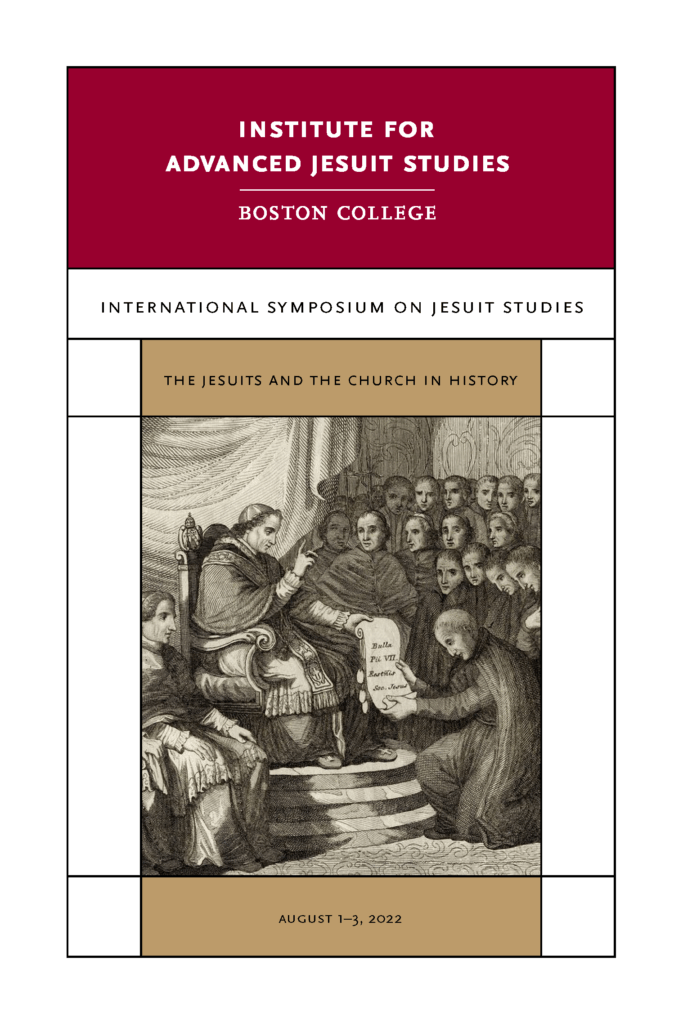
“A big subject”—that is how John O’Malley describes the topic of the relationship between the Society of Jesus and the papacy.[1] We might easily say the same about the broader relationship between the Jesuits and the church. Confronting such a vast subject, this paper merely attempts to approach it from the perspective of the Jesuit Roman Archives (hereafter ARSI, which stands for Archivum Romanum Societatis Iesu).[2] The purpose of the undersigned author is to introduce some of the archival documents there that provide examples of this relationship. Given that the Society of Jesus as a religious order has been approved by the church and consequently operates within it, the first part of the paper will focus on the ecclesiastical approbation of the Jesuits, while the second will deal with some of the Society’s activities that had been undertaken as mission from the church that had originally chartered it.
Approved by the Church
At the beginning of the Formula Instituti—in both its versions: from 1540 and from 1550—we read that the service to God to which the Jesuits devote themselves is to be exercised under the authority of the bishop of Rome.[3] An obvious consequence of that was the series of approvals granted by the popes, starting with Paul III (r.1534–49), who allowed the followers of Saint Ignatius of Loyola first to exist as a religious order in the church, and second to act within the limits established by the successive pontiffs. Many popes issued several permissions and even granted special privileges to the Jesuits. However, among the popes there were also those who for various reasons limited the latitude that their predecessors had granted—the most extreme limitation being the canonical suppression of the order in 1773.
All authoritative ecclesiastical decisions concerning the Jesuits are registered in the ARSI, but the originals of well-known and frequently published documents may not be extant.[4] Surprising as such documentary lacunae may seem, they are easily explained by historical vicissitudes, particularly during the time of the suppression.
After 1814, the same excuse hardly applies. Whereas it is easy to attribute the absence of the Society’s foundational bulls to the events following 1773, as the archivist Edmond Lamalle does,[5] it is less understandable why the shelves do not contain (to the best of my knowledge) the original of the Sollicitudo omnium ecclesiarum—that document that, according to the contemporary witnesses, was given to Fr. Luigi Panizzoni (the head of the Italian Jesuits) during the ceremony re-establishing the Society of Jesus held August 7, 1814 at the Gesù in Rome.[6] What happened to this document, then, an item as well known as it is significant for the Society’s history? Some attempts to find it, undertaken by this author in 2014 on the occasion of the bicentenary of the restoration, proved unsuccessful. Equally disappointing were similar attempts to find the original of the 1804 brief Per alias, effecting the re-establishment the Society of Jesus in the Kingdom of the Two Sicilies.[7]
On the other hand, the documentary evidence of several important steps leading to the 1814-event is not missing. Among them, there is the papal brief Catholicae fidei from 1801, by which Pius VII (r.1800–23) recognized and canonically confirmed the Society in Russia.[8] Another important document is the autograph of the declaration from 1785 in which Jan Benisławski (the messenger sent by the Russian empress Catherine II [r.1762–96] to Rome) gave formal witness to Pius VI’s (r.1775–99) 1783 oral approval of the existence of the Society in Belarus.[9]
In fact, there are entire sections of ARSI reserved for documentation relating to that special chapter of the Society’s history that spans the suppression and the restoration of the order. The series Historia Societatis is the locus for more than a hundred archival units concerning the 1773-event and several local expulsions that preceded it.[10] Additionally, the entire Fondo Gaillard with its 105 archival units occupying 8.5 meters of shelves would be of even greater interest as it contains the result of more than thirty years of research that this French Jesuit did in many European archives, including those of Moscow and Saint Petersburg—all in order to study that troubled period of the Society’s history.[11]
Of an obvious interest also is the already cited series Russia, because it contains the documentation of the survival of the Jesuits in the territory of the Russian empire after 1773.[12] Only one example will be quoted here to show its importance: the correspondence between two Polish Jesuits: Karol Korycki (one of Superior General Lorenzo Ricci’s [in office 1758–73] assistants who was imprisoned with him for more than two years in the Roman Castel Saint Angelo and who eventually died in the Eternal City in 1783) and Stanisław Czerniewicz (the head of the Jesuits surviving in Belarus).[13] Between 1779 and 1783, Korycki kept providing his younger companion with wise advice about how to proceed in a very delicate situation: the un-suppressed Jesuits did not know what to do in their position between Rome and the pope on one hand, and on the other Tsarina Catherine II, who had formally forbidden the dissolution of their religious community. In these twenty-eight letters, we can see a constant preoccupation with being faithful and obedient to the church, but also with not giving up in the face of the assaults that the Society’s enemies were making against its last remnants. The importance of this material appears also in the project contemplated by the Jesuit generals at the turn of the twentieth century to publish a French translation of these Polish letters. The project never materialized. Both the letters and their translation remain in the archives.
To return to the early origins of the Society: its Roman archives preserve several important items bearing on the relationship of its first members with the ecclesiastical authorities. Some of those documents date even from the time preceding the 1540 approval. Among them we may quote the original of the diploma magister artium received by Saint Ignatius in 1535 in Paris[14] or the certificate from 1536 confirming that he had attended theology classes in the French capital for a year and a half.[15]
Given the troubles the Society’s founder had with the Inquisition, a document from January 1537 of obvious importance and interest is the one in which the inquisitor from Paris testifies that Loyola and his companions are not heretics.[16] The same year appears on the permission for ordination, granted in the name of Pope Paul III to the future first Jesuits.[17] The certificate of the ordination of Saint Ignatius testifies that this permission was used.[18]
One may hardly overestimate the value of the documents collected by earlier archivists in the volume Historia Societatis 1a. Of interest for the present paper is all that illustrates how the first fathers put into practice what Paul III granted them in 1540, namely the permission to choose their superior general. The celebrated events from April 1541 have left their traces in some of the original ballots, which remarkably have been preserved. Thanks to them, we can not only verify the credibility of the election but also admire the clear calligraphy of Saint Ignatius,[19] the one of Diego Laínez called endiablada by one of his recent biographers,[20] and that of Alfonso Salmerón,[21] Paschase Broët,[22] Jean Codure,[23] and Claude Jay.[24] As for those of the first companions who were not in Rome at that time, the written declarations of Simão Rodrigues,[25] of Saint Francis Xavier,[26] and of Saint Peter Faber[27] are evidence of their vote and provide some rare authentic handwriting samples remaining in these archives. Together with all those ballots, a precious relic is also the formula of the final vows taken by six of the first
Jesuits on April 22, 1541 in the Roman Basilica of Saint Paul Outside the Walls.[28]
Another particular aspect of the ecclesiastical approval granted to the Society of Jesus by the popes emerges when the bishops of Rome intervene in Jesuits’ life, government, and work. Historians report several such interventions.[29] Given the limits of the present paper, only the first (from 1558) and the last (from 1981) of the most important of them will be recalled. Both are mirrored in the documents preserved in ARSI.
In 1558, during the First General Congregation of the order, Paul IV (r.1555–59) sent to the assembly his special envoy—Cardinal Pedro Pacheco de Villena—with the mission to serve as secretary for that gathering and to count the votes during the election of the new superior general. Later on, as the congregation proceeded with its work, the fathers knew that the pope’s intention was to change the rule of life-term of the Jesuit generalate as well as to introduce the choir into the Society. Since these plans were never officially instituted, they had a life no longer than that of Paul IV, who died less than one year later.[30]
Some documentary evidence memorializes the 1558 events. For example, in that year, Laínez and Salmerón signed a handwritten testimony of their discussions with the pope, representing the objections of the congregation to the proposed innovations.[31] Adopting these changes for a year but then returning to the original Ignatian idea led to a singular editorial situation for the Constitutions of the Society of Jesus, first printed in Latin in the Roman College in 1558–59.[32] As reported by the bibliographer Carlos Sommervogel, the book was printed twice, with slight differences on the final page: the first version contains the note about what the pope had decided to introduce into the Society, while the second version has no sign of this note.[33][34] Even more curious is the copy of this first edition preserved in the Roman Archives where the above-mentioned note is added in handwriting on the last page, from where it had been apparently cut off earlier.[35]
The events of 1981 present us with another extraordinary chapter of contemporary Jesuit history. These archives are not yet open. Mirroring the policy of the Vatican Archives, the Society makes its Roman Archives available up to October 1958, that is, the end of the pontificate of Pius XII (r.1939–58). Nevertheless, some of the relevant documents concerning this issue have been published and as such are publicly known and can be quoted here.
When in 1981 John Paul II (r.1978–2005) appointed Paolo Dezza his special delegate for the Society of Jesus, this pontifical decision was communicated first to Superior General Pedro Arrupe (in office 1965–83) (recovering from his stroke) by a letter brought to the curia by Cardinal Agostino Casaroli. Dated October 5, 1981, and signed by the pope, this letter has been published and is well known.[36] Its original is preserved in the archives and appears as a witness of that unusual story, which already has its own bibliography and sometimes contrasting evaluations.[37]
Indeed, to understand the pope’s decision it is necessary to look at its context, that is, all that had happened in the church and in the Society of Jesus since Vatican II (1962–65). Undertaking the necessary conciliar reforms brought not a few new challenges also for the Jesuits who were facing them in different ways. As in many other ecclesial structures, here also the opinions and points of view varied (and probably still do). Such differences were part of the last century’s history of Jesuit–church relations (taking the church under the aspect of the ecclesiastical authorities, local and central-Roman). Only one episode and one document illustrating it will be enough to provide a relevant example.
During General Congregation 32, one of the important issues that occupied the attention of the delegates was the question of grades in the Society. The previous general congregation had already registered that problem, without, however, saying the last word about it. Thus, in 1974 there were many postulates concerning the same topic, with the majority of the congregation members wanting to face this problematic subject. Given its importance, the information was transmitted to the Holy See. Its answer was issued on December 3, 1974 in a letter from Cardinal Jean-Marie Villot to Fr. Arrupe. This communication (later published) clearly stated that the proposed changes in the structure of the grades would not receive the necessary approval.[38] There resulted an extremely difficult and complex relationship between the Society of Jesus and the pope.
Certainly, it is too early, given the inaccessibility of the archives (and not only the Jesuit archives), to explain all the nuances of this chapter of the order’s history. On the other hand, the theme is far from insignificant, particularly because of the ongoing beatification process of Pedro Arrupe. Will its proceedings require clarifications on that point and arrive at answers to the questions that emerge? If yes, it will be of considerable historical significance for both the Society and the church.
Missioned by the Church
“Mission” is a word that has had several definitions in ecclesiastical usage over the centuries. At present, the classic concept of “foreign missions” (referring to the sending of European missionaries to other continents) has been more than nuanced. Indeed, for a long time the non-European churches have developed to such an extent that their condition—at least in some respects, like the number of clergy and the frequency of sacramental activities—is better than that of the Catholic communities in the increasingly secularized Western world. The Jesuit understanding of mission was always broader than that which was limited to foreign missions, as we find in the entire seventh part of the Society’s Constitutions.[39]
If by “mission” we understand everything that Jesuits are doing, and if we see it as relevant for their relationship with the church, the entire archives should be taken into consideration here, because they provide the evidence of these activities, being a mirror of all that the Society was doing. Even if we limit our understanding to the classical idea of “foreign missions,” and if we consider them as a part of Jesuit–church relations, we also will be overwhelmed by the quantity of archival material held in Rome and relevant to this topic.[40] We must of course limit our treatment here to only a few select instances and documents.
A good starting point for it are numerous letters written by Jesuit missionaries to their Roman superiors. Among their authors are such famous names as Matteo Ricci but also less-celebrated members of the Society. Ricci’s writings are published, translated (at least in part) into other languages, and often quoted. It is a great privilege of ARSI to have, as part of their precious heritage, several of the originals of his writings, for example the book Della entrata della Compagnia di Giesù e Christianità nella Cina (The entrance of the Society of Jesus and Christianity into China).[41] We also have a very interesting letter of his, from January 17, 1593: he appended to it a sheet with Chinese characters, their transliteration and translation—all in order to explain to the superior general what the Chinese language is like.[42]
Less known than Ricci but the subject of increasing research (even beyond his native Poland) is Michał Boym, another Jesuit missionary in seventeenth-century China.[43] His adventures are an example of what today we would call “diplomatic service” offered both to the church and to China. Traveling there in the usual manner of those days, Boym had to stop in Mozambique. From there, in 1644 he wrote to his fellow Jesuits in Rome a report with interesting drawings of plants and animals that he had seen in that African country.43 More than a hundred years later, another Jesuit would write similar descriptions, with drawings of plants and animals—the Spaniard José Sánchez Labrador, who worked as missionary in Paraguay, from where he was expelled in 1767, ultimately to Italy, where he wrote his multi-volume work (of which only a small part has been published).[44]
To return to Boym: arriving in China in 1645, he was sent back to Europe five years later as a special messenger of the Ming dynasty, which was at that time pushed south by the Manchu invaders who would eventually replace it as the new rulers of the empire. Having enough influence at the Ming court, Boym received the letters with the request for help that the empress Wang (baptized with the Christian name Helen) addressed to the pope and to the general of the Jesuits. Reaching Rome in 1653 after many adventures on that long journey, the Jesuit accomplished his mission and delivered those letters. Written on silk and sealed with the imperial seals, both of the originals have survived. The one destined for the pope is considered one of the most precious treasures of the Vatican Archives. It is exhibited on special occasions.[45] The other, addressed to the general of the Society of Jesus, remains in the ARSI.[46] Boym returned to China in 1658, but the situation had already changed: the Manchu had taken control.
A great deal has been published about the Chinese Rites controversy. Involved as they were, the Jesuits authored many publications and left several handwritten documents that provide valuable material for the historians. The recently published Acta Pekinensia are an outstanding example of this contemporary interest in that theme.[47] The handwritten original of the Acta is a part of the ARSI collections.[48]
Some other volumes stored as Japonica-Sinica unfortunately have not yet been published. Among them, notable for their quantity as well as for their content, can be found the writings of the Polish Jesuit Tomasz Ignacy Szpot Dunin. While serving as a confessor in the Basilica of Saint Peter in Rome (1689–1713), he dedicated much time and effort to researching the history of the missions in China. The fruit of his labors amounts to around 4,500 pages that fill eight volumes of the Historia Sinarum along with several Collectanea. Both collections date from about the same time as the Acta Pekinensia, that is, from the years of the controversy’s disappointing denouement.[49]
Furthermore, the entire series of Japonica-Sinica I–IV containing the Chinese books sent more or less at the same time to Rome by the Jesuits from the Far East is a witness of their unsuccessful attempts to defend their missionary strategies before the Roman authorities.[50] The Jesuits failed in convincing the latter, but eventually history favored them rather than their adversaries.
Quite different were the vicissitudes of the mission in Japan. Starting in 1549 and developing to the point of becoming an independent province of the Society of Jesus in 1611, it was destroyed by harsh persecutions in the first decades of the seventeenth century. Among the many documents referring to this mission are the letters of several Jesuit missionaries who ended as martyrs.[51] A rather unknown one was Wojciech Męciński. His adventures were comparable to those of characters portrayed in the Martin Scorsese movie Silence (2016). In fact, Męciński died in Nagasaki in 1643, after months of tortures. He did not apostatize.[52] Other documents recall less glorious sides of the same story. There is the attestation of the dismissal of Cristóvão Ferreira from the Society of Jesus, issued as consequence of his apostasy under torture in 1633.[53]
Another particular way to serve the missionary church entailed accepting what they had renounced in one of their vows, for example ecclesiastical dignities (usually the bishopric) in one of the missionary territories. Actually, there had been precedents for such exceptions in a work managed by Saint Ignatius himself with hope and enthusiasm—the mission in Ethiopia. Loyola’s correspondence proves that he wanted his fellow Jesuits to accept the episcopal ordination and even the title of patriarch—all for the good of the planned activity in the Kingdom of the Priest John.[54] Since that time, many members of the Society of Jesus have become bishops or received other ecclesiastical dignities when it was necessary to apply the exception allowed by Saint Ignatius.[55] Two cases serve as example for this in Africa during the last two centuries.
Maksymilian Ryłło died in 1848 in Khartoum. He arrived there bearing the title of pro-vicar apostolic, being the head of a new mission in this part of the Dark Continent. The life of this missionary would also be good material for a movie. Having escaped from his native country under the Russian occupation, he entered the Jesuits in Rome in 1820 and successfully engaged in a range of pastoral activities in Italy, Malta, the Near East, and, finally, Africa. Some of his extant letters in Rome testify to the many adventures of his travels.[56]
Interesting in a different but no less complicated way is the life of Adam Kozłowiecki, another Polish missionary in Africa. After more than five years spent in German concentration camps, he arrived in 1946 in today’s Zambia and dedicated the rest of his life to work in that country. A simple missionary during the first years, he was appointed administrator apostolic of Lusaka in 1950. In 1955, he became the first bishop of that city, then its first archbishop in 1959, and eventually, in 1998, cardinal.[57] More than two hundred of his extant letters in ARSI offer a wide panorama of the complex aspects of missionary work in the context of decolonization and the development of the African church that he so remarkably served.
Quite an interesting example of serving the church is found in documentation concerning Edmund Walsh—an American Jesuit who was head of the humanitarian mission in the Soviet Union in 1922–24, when starvation was so serious that the authorities allowed a pontifical mission to be organized and to work in Russia.[58] Fr. Walsh reported regularly to the Vatican but also to his religious general superior. That is why so many of his letters (around 150) are available. They were scheduled to be published in a Russian translation as part of a promising project of the Russian Academy of Sciences, though sadly circumstances have delayed their appearance.[59]
It would be easy to multiply similar examples citing other archival evidence concerning materials similar to those mentioned in our survey here. A plethora of documents awaits interested scholars, and ARSI welcomes them. Finally, it is worth mentioning once again the series Santa Sede already quoted: it contains the correspondence between the Holy See and the Jesuit general curia, that is, mainly letters arrived from the popes and several Vatican offices, especially from the last two centuries.[60] The series Regesta, Santa Sede is its complement. It contains the copies of the answers to these letters. There is no better section of the archives for the study of the relations between the two curias, Vatican and Jesuit.
Bonds Prevailing over Fissures
The book by O’Malley cited at our outset starts with a remark that is as pertinent as it is obvious: the relationship between the Society of Jesus and the papacy is not an equal one, because the popes could exist without the Jesuits, but the Jesuits could not exist without the popes.[61] Here again we could say the same about the relationship between the Society of Jesus and the church. Once again, O’Malley rightly says that—despite the problems and difficulties of that unequal relationship—the fact that the Society has lasted for almost five centuries proves that its bonds with the church have been stronger than its fissures. The voluminous documents of the Jesuit Roman Archives provide more than enough evidence of that.
Notes:
[1] John W. O’Malley, The Jesuits and the Popes: A Historical Sketch of Their Relationship (Philadelphia: Saint Joseph’s University Press, 2016), 1.
[2] A comprehensive history of these archives does not yet exist, but there are several articles that provide a good introduction to them. Of particular interest are the writings of some former archivists: Edmond Lamalle, “L’archivio di un grande ordine religioso: L’Archivio Generale della Compagnia di Gesù,” Archiva ecclesiae 24–25 (1981–82): 89–120, and Josef Teschitel, “L’organizzazione dell’archivio generale della Compagnia di Gesù,” Rassegna degli Archivi di Stato 22 (1962): 189–96.
[3] John W. Padberg, ed., The Constitutions of the Society of Jesus and Their Complementary Norms: A Complete English Translation of the Official Latin Texts (Saint Louis, MO: Institute of Jesuit Sources, 1996), 3.
[4] The most complete edition of such documents in their original Latin version is Institutum Societatis Iesu, vol. 1, Bullarium et compendium privilegiorum (Florence: Typographia A. SS. Conceptione, 1892).
[5] Lamalle, “L’archivio di un grande ordine religioso,” 115.
[6] Concerning the events of August 7, 1814, see: Manuel Revuelta González, El restablecimiento de la Compañía de Jesús: Celebración del bicentenario (Bilbao: Ediciones Mensajero, 2013), 136–37. For the English version of the bull, see Thomas McCoog, ed., Promising Hope: Essays on the Suppression and Restoration of the English Province of the Society of Jesus (Rome: Institutum Historicum Societatis Iesu, 2003), 326–30.
[7] The English version of this brief: McCoog, Promising Hope, 321–22.
[8] ARSI, Russia 1004-VI-7 (published: Institutum Societatis Iesu, 1:332–35; English version: McCoog, Promising Hope, 315–18). About the survival of the Society of Jesus in Russia, see Marek Inglot, How the Jesuits Survived Their Suppression: The Society of Jesus in the Russian Empire (1773–1814) (Philadelphia: Saint Joseph’s University Press, 2015).
[9] ARSI, Russia 1001-VII-1 (published in English: Inglot, How the Jesuits Survived Their Suppression, 98–99).
[10]ARSI, Hist. Soc. 182–300. An old but detailed inventory helps in the first orientation in its content, particularly for the volumes 182–238.
[11] ARSI, Hist. Soc. 1001–11 (the rest of the Fondo Gaillard is composed of fifty-one large notebooks and forty-three file folders containing the transcription of the documents found by the French Jesuit in several archives). About François-Marie Gaillard, his work, and the relative ARSI documentation, see Robert Danieluk, “A Failed Mission or a ‘Never-Ending Tertianship’? François-Marie Gaillard, S.J. (1853–1927) and His Contribution to the Historiography of the Society of Jesus,” Archivum historicum Societatis Iesu 82, fasc. 163 (2013): 3–113.
[12] See the inventory of that series: Andrzej Paweł Bieś et al., Polonica w Archiwum Rzymskim Towarzystwa Jezusowego, t. 5, Russia, Polonica in the Jesuits Roman Archives, t. 5: Russia (Kraków: Wyższa Szkoła Filozoficzno-Pedagogiczna Ignatianum/Wydawnictwo WAM, 2008).
[13] ARSI, Russia 1003-III [entire file]; 1003-IV-5 and 7; 1003-V-1 and 2; Hist. Soc. 1002; 1010-I. About this correspondence, see: Robert Danieluk, “I Polacchi negli archivi della curia generalizia della Compagnia di Gesù,” in I Polacchi e le loro storie private negli archivi italiani e vaticani: Atti del convegno, Roma 20–21 ottobre 2016, Conferenze 136 (Rome: Accademia Polacca delle Scienze Biblioteca e Centro di Studi a Roma, 2017), 82–97.
[14] ARSI, Epp. NN 89, doc. 12 (published: Scripta de sancto Ignatio de Loyola Societatis Jesu fundatore [Madrid: Typis Gabrielis López del Horno, 1918], [Monumenta Historica Societatis Iesu (hereafter, MHSI) 56], 2:1–2.
[15] ARSI, Epp. NN 89, doc. 12 (published: MHSI 56:2–3).
[16] ARSI, Epp. NN 89, doc. 25 (published: MHSI 56:3).
[17] ARSI, Epp. NN 89, doc. 26 (published: Scripta de sancto Ignatio de Loyola Societatis Jesu fundatore [Madrid: Typis Gabrielis López del Horno, 1904] [MHSI 25], 1:544–45).
[18] ARSI, Epp. NN 89, doc. 27 (published: MHSI 25:543–46).
[19] ARSI, Hist. Soc. 1a, fol. 16r (published: MHSI 56:5).
[20] ARSI, Hist. Soc. 1a, fol. 18r (published: Epistolae et acta Patris Jacobi Lainii secundi praepositi generalis Societatis Jesu ex autographis vel originalibus exemplis potissimum deprompta a patribus ejusdem Societatis edita [Madrid: Typis Gabrielis López del Horno, 1917], [MHSI 55], 8:638). The expression endiablada caligrafía is in Antonio Alburquerque, Diego Laínez, S.J.: Primer biógrafo de S. Ignacio (Bilbao: Ediciones Sal Terrae, 2005), 20.
[21] ARSI, Hist. Soc. 1a, fol. 23r (published: Epistolae P. Alphonsi Salmeronis Societatis Jesu ex autographis vel originalibus exemplis potissimum depromptae a patribus ejusdem Societatis nunc primum editae [Madrid: Typis Gabrielis López del Horno, 1906], [MHSI 30], 1:1–2).
[22] ARSI, Hist. Soc. 1a, fol. 19r (published: Epistolae PP. Paschasii Broëti, Claudii Jaji, Joannis Codurii et Simonis Rodericii Societatis Jesu ex autographis vel originalibus exemplis potissimum depromptae [Madrid: Typis Gabrielis López del Horno, 1903], [MHSI 24], 23).
[23] ARSI, Hist. Soc. 1a, fol. 25r (published: MHSI 24:418–19).
[24] ARSI, Hist. Soc. 1a, fol. 17r. Apparently, this ballot was not published in the Monumenta, see Dionysius Fernández Zapico, Candidus de Dalmases, and Pedro Leturia, eds., Fontes narrativi de s. Ignatio de Loyola et de Societatis Iesu initiis (Rome: Apud “Monumenta Historica Soc. Iesu,” 1943), [MHSI 66], 1:17.
[25] ARSI, Hist. Soc. 1a, fol. 25r (published: MHSI 24:519).
[26] ARSI, Hist. Soc. 1a, fol. 258rv (published: Monumenta Xaveriana ex autographis vel ex antiquioribus exemplis collecta [Madrid: Typis Augustini Avrial, 1899–1900], [MHSI 16], 1:810–14).
[27] ARSI, Hist. Soc. 1a, fol. 20r–21r (published: Beati Petri Fabri primi sacerdotis e Societate Jesu epistolae, memoriale et processus, ex autographis aut archetypis potissimum deprompta [Madrid: Typis Gabrielis López del Horno, 1914], [MHSI 48], 52–53).
[28] ARSI, Hist. Soc. 1a, fol. 14v (published: Sancti Ignatii de Loyola Constitutiones Societatis Jesu [Rome: Borgo S. Spirito 5, 1934], [MHSI 63], 1:67–68).
[29] William V. Bangert, A History of the Society of Jesus, 2nd ed. (St. Louis, MO: Institute of Jesuit Sources, 1986), passim. Michela Catto and Claudio Ferlan, I gesuiti e i papi (Bologna: Società Editrice Il Mulino, 2016). O’Malley, Jesuits and the Popes, passim. John. W. Padberg, “The Papacy and the Society: Often a Bumpy Relationship,” National Jesuit News (1981): 10–12, 20.
[30] John W. Padberg, Martin D. O’Keefe, and John L. McCarthy, eds. and trans., For Matters of Greater Moment: The First Thirty Jesuit General Congregations; A Brief History and a Translation of the Decrees (St. Louis, MO: Institute of Jesuit Sources, 1994), 3–4, 81–82. Charles E. O’Neill and Christopher J. Viscardi, “Paulo IV,” in Diccionario histórico de la Compañía de Jesús: Biográfico-temático (Rome: Institutum Historicum S.I., 2001), 3:2971–72.
[31] ARSI, Instit. 185-I, fol. 2rv (published: MHSI 55:673–75).
[32] Constitutiones Societatis Iesu: Anno 1558 (Rome: In aedibus Societatis Iesu, 1558).
[33] Carlos Sommervogel, ed., Bibliothèque de la Compagnie de Jésus (Brussels: O. Schepens, 1894), 5:cols. 75–77.
[34] Constitutiones, 159 (ARSI, Instit. I 58).
[35] Acta Romana Societatis Iesu 18, no. 1 (1981): 399–403 (the original of the letter in ARSI, Santa Sede 1211-I).
[36] To quote only a few authors that treat this problematic in different ways and not to an equal extent: Valentí Gómez-Oliver and Josep M. Benítez, 31 jesuitas se confiesan: Imago mundi (Barcelona: Ediciones Península, 2003). Gianni La Bella, I gesuiti: Dal Vaticani II a Papa Francesco (Milan: Guerini e Associati, 2019). John W. Padberg, Together as a Companionship: A History of the Thirty-First, Thirty-Second, and Thirty-Third General Congregations of the Society of Jesus (St. Louis, MO: Institute of Jesuit Sources, 1994). Urbano Valero Agúndez, Pablo VI y los jesuitas: Una relación intensa y complicada (1963–1978) (Bilbao: Mensajero, 2019).
[37] Acta Romana Societatis Iesu 16, no. 2 (1974): 446 (the original of the letter in ARSI, Santa Sede folder “Paolo VI, 1974–1975”—a temporary collocation, for this part of the ARSI documentation has not yet been inventoried).
[38] Gerard O’Hanlon, “Mission,” in The Cambridge Encyclopedia of the Jesuits, ed. Thomas Worcester (Cambridge: Cambridge University Press, 2017), 525–26. Ignasi Salvat, “Misión,” in Diccionario de la espiritualidad ignaciana, 2nd ed. (Bilbao: Ediciones Mensajero, 2007), 1239–46.
[39] See this author’s attempt to introduce the Jesuit Roman Archives as a privileged tool for studying the history of the Society’s foreign missions: “Archivum Romanum Societatis Iesu: Un luogo privilegiato per lo studio dell’attività evangelizzatrice dei gesuiti,” Archiva ecclesiae 53–55 (2014): 221–54.
[40] ARSI, Jap. Sin. 106a.
[41] ARSI, Jap. Sin. 12, folio without number, placed between fols. 92 and 93. Published: Song Liming 宋黎明, Shenfu de xinzhuang: Li Madou zai Zhongguo (1582–1610) 神父的新装: 利玛窦在中国 [1582–1610]
[The father’s new vestments: Ricci in China] (Nanjing: Nanjing daxue chuban she, 2011), 80 (I thank Prof. Ad Dudink and Prof. Nicolas Standaert, S.J. from the Katholieke Univeristeit Leuven for providing me with information about this publication). Actually, in the letter Ricci says to Acquaviva that he attached to it four big sheets with some moral sentences in Chinese characters, and one smaller sheet with the explanation of them. It is the latter that is quoted here above.
[42] About him, his mission, and the documents relating to it, see Robert Danieluk, “Michał Boym, Andrzej Rudomina, and Jan Smogulecki: Three Seventeenth-Century Missionaries in China; A Selection of Documents from the Roman Jesuit Archives,” Monumenta serica: Journal of Oriental Studies 59 (2011): 417–43. 43. ARSI, Goa 34, fols. 150r–160r (published: Robert Wallisch, Michael Boyms Bericht aus Mosambik: 1644 [Lateinischer Text; Übersetzung und Kommentar] mit ethnographischen Paralleltexten des 16. und 17 Jahrhunderts aus der Wiener Sammlung Woldan [Vienna: Verlag der Österreichischen Akademie der Wissenschaften, 2005]).
[43] ARSI, Goa 34, fols. 150r –160r (published: Robert Wallisch, Michael Boyms Bericht aus Mosambik: 1644 [Lateinischer Text; Übersetzung und Kommentar] mit ethnographischen Paralleltexten des 16. und 17 Jahr-hunderts aus der Wiener Sammlung Woldan [Vienna: Verlag der Österreichischen Akademie der Wissenschaften, 2005]).
[44] ARSI, Paraq. 16–20. About his publications, see https://dbe.rah.es/biografias/15236/francisco-jose- sanchez-labrador (accessed July 9, 2023).
[45] AAV, A.A., Arm. I–XVIII 1790. About this letter, see: Lux in arcana: L’Archivio Segreto Vaticano si rivela (Rome: Palombi Editori, 2012), 26–27.
[46] ARSI, Jap. Sin. 186.
[47] Kilian Stumpf, The Acta Pekinensia, or Historical Records of the Maillard de Tournon Legation, vol. 1, ed. Paul Rule et al. (Rome: Institutum Historicum Societatis Iesu, 2015). Stumpf, The Acta Pekinensia, or Historical Records of the Maillard de Tournon Legation, vol. 2, ed. Paul Rule and Claudia von Collani (Leiden: Brill, 2019).
[48] ARSI, Jap. Sin. 138.
[49] ARSI, Jap. Sin. 102–5 I–II; 109–11; 125, fols. 200r–234r; 194, fols. 34r–44v. About Szpot and his work, see Robert Danieluk, “Konfesjonał i pióro: Tomasz Ignacy Szpot Dunin, polski historiograf jezuickiej misji w Chinach,” in Iesuitae in Polonia—Poloni Iesuitae: Piśmiennictwo łacińskie czasów nowożytnych, ed. Jarosław Nowaszczuk (Szczecin: Volumina, 2017), 75–108.
[50] See the inventory of this rich collection: Albert Chan, Chinese Books and Documents in the Jesuit Archives in Rome: A Descriptive Catalogue Japonica–Sinica I–IV (Armonk: An East Gate Book, 2002).
[51] ARSI, Jap. Sin. 34–38 (actually, as we can read on their covers, these volumes were called Autographa martyrum).
[52] About him and his letters, see Robert Danieluk, “Long Way to Japan—Short Way to Martyrdom: Wojciech Męciński, S.J., and His Letters in the Jesuit Roman Archives,” Perspektywy kultury 21, no. 2 (2018): 89–126.
[53] ARSI, Jap. Sin. 18–II, fol. 256rv. About Ferreira and his story, see Hubert Cieslik, “The Case of Christóvão Ferreira,” Monumenta Nipponica 29, no. 1 (1974): 1–54, https://archive.org/details/sim_monumenta-nipponica_1974_29_contents (accessed August 13, 2023).
[54] About these letters, see Robert Danieluk, “Przygotowanie jezuickiej misji w Etiopii w świetle listów św. Ignacego Loyoli,” Annales missiologici Posnanienses 21 (2016): 101–16.
[55] Angel Santos Hernández, Jesuitas y obispados, t. 1–2 (Madrid: Universidad Pontificia Comillas, 1998– 2000).
[56] About him and his letters, see Robert Danieluk, “Maksymilian Ryłło, S.J. (1802–1848) and the Beginnings of the New Catholic Mission in Africa in the Nineteenth Century,” Annales missiologici Posnanienses 23 (2018): 7–21.
[57] About him, see Robert Danieluk, “God’s Stopgap: Cardinal Adam Kozłowiecki, S.J.,” Journal of Jesuit Studies 7 (2020): 642–60.
[58] About Walsh and the mission, see: Maria Chiara Dommarco, Un compito eccezionale e rischioso: Il governo bolscevico e la missione della Santa Sede al tempo della carestia degli anni Venti (Moscow: Institut sv. Fomy—Seriate, “La Casa di Matriona,” 2020).
[59] ARSI, Russia 2001-[fascicles III–V]; 2002-[fascicles I–V]; 2003- [fascicles II–III, V]; 2006-[fasc. II–IV, VII]; 2007-V; 2008-II. About the project, see: Evgenia Tokareva, “Edmund Walsh, Vatican Plans, and Russian Reality of 1922–1923,” Rossijskaja istorija 4 (2020): 188–204 (in Russian). On the mission, see also Louis J. Gallagher, S.J, A Jesuit Cossack: A Memoir, ed. Joseph P. Duffy, S.J. (2018), https://jesuitarchives. omeka.net/items/show/936 (accessed July 9, 2023).
[60] About this series, see Sergio Palagiano, “Il fondo Santa Sede nell’Archivum Romanum Societatis Iesu (ARSI) tra Antica e Nuova Compagnia: Analisi archivistica e prospettive di ricerca,” Archivum historicum Societatis Iesu 86, fasc. 171 (2017): 99–144.
[61] O’Malley, Jesuits and the Popes, 1–2.
- Title: Jesuits and the Church in Light of the Society’s Roman Archives
Author: Robert Danieluk, S.J.
Article Type: Research Article
DOI: 10.51238/ISJS.2022.07
Language: English
Pages: 1–11
Keywords: - Volume: 2
- Issue: 1, special issue
Publication Date: 30 November 2023
Last Updated: 30 November 2023
Publisher: Institute of Jesuit Sources
E-ISSN: 2766-0644
ISBN: 978-1-947617-19-3
APA
Danieluk, R., S.J. (2023). Jesuits and the Church in light of the Society’s Roman … In C. Pavur, S.J., B. Geger, S.J., & R. Gerlich, S.J. (Eds.), The Jesuits and the Church in history (Proceedings of the symposium held at Boston, August 1–4, 2022) [Special issue]. International Symposia on Jesuit Studies, 2(1), 1–11. https://doi.org/10.51238/ISJS.2022.07
CMOS
Danieluk, Robert, S.J. “Jesuits and the Church in Light of the Society’s Roman In “The Jesuits and the Church in History (Proceedings of the Symposium held at Boston, August 1–4, 2022),” ed. Claude Pavur, S.J., Barton Geger, S.J. and Robert Gerlich, S.J., special issue, International Symposia on Jesuit Studies 2, no. 1 (2023): 1–11. https://doi.org/10.51238/ISJS.2022.07.
MLA
Danieluk, Robert, S.J. “Jesuits and the Church in Light of the Society’s Roman …” The Jesuits and the Church in History (Proceedings of the Symposium held at Boston, August 1–4, 2022), edited by Claude Pavur, S.J., Barton Geger, S.J., and Robert Gerlich, S.J., special issue of International Symposia on Jesuit Studies, vol. 2, no. 1, 2023, pp. 1–11. https://doi.org/10.51238/ISJS.2022.07.
Turabian
Danieluk, Robert, S.J. “Jesuits and the Church in Light of the Society’s Roman …” In “The Jesuits and the Church in History (Proceedings of the Symposium held at Boston, August 1–4, 2022),” ed. Claude Pavur, S.J., Barton Geger, S.J., and Robert Gerlich, S.J., special issue, International Symposia on Jesuit Studies 2, no. 1 (2023): 1–11. https://doi.org/10.51238/ISJS.2022.07.