



Book Chapter
Catechesis and Inculturation, Pedro Arrupe (1977)
Originally in: Pedro Arrupe, S.J. ,”Catechizing the Whole World,” in Other Apostolates Today: Selected Letters and Addresses—III, ed. Jerome Aixala. St. Louis: The Institute of Jesuit Sources, 1981, 163–67.
DOI: 10.51238/077S15C
Arrupe, Pedro, S.J. “Catechizing the Whole World, Pedro Arrupe (1977).” In Essential Documents: Selected Sources for Jesuit History, edited by Institute for Advanced Jesuit Studies. Institute of Jesuit Sources, July 15, 2026. https://doi.org/10.51238/077S15C
Info and Contents
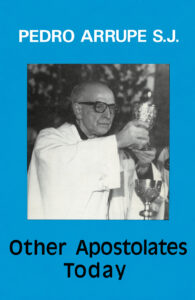
Other Apostolates Today
Selected Letters and Addresses—III
 Open Access
LCCN: 81080741
ISBN10 (hcv): 0-912422815
ISBN10 (pbk): 0-912422807
ISBN (hcv): 978-0-912422-44-2
ISBN (pbk): 978-0-912422-80-0
Copyright: 1981
Publisher: Institute of Jesuit Sources
The Synod of Bishops on Catechesis took place in October 1977. Superior General Pedro Arrupe delivered two addresses during the meetings, the first of which appears below. The remarks address the relationship between catechesis and inculturation. “The absence of inculturation,” Arrupe states, “is one of the main obstacles to evangelization.” To assist, he identifies some of the difficulties in and guiding principles for inculturation.” If the faith allows itself to be imprisoned in a particular culture, it suffers from the limitations of that culture,” Arrupe declares. “There has to be a continuing dialogue between the faith and all cultures.”
One of the important problems which the Church and catechesis in particular have to face is the real influence of faith on the living conditions of man, on his culture. One element which can lead to a solution of this vital problem is “inculturation.” The absence of inculturation is one of the main obstacles to evangelization.
Catechesis presupposes the inculturation of the faith; catechesis comes after this inculturation; and likewise catechesis continues to be a very powerful and dynamic means of inculturation.
What Inculturation in Catechesis is Not
—is not merely an adaptation of older forms of catechetical instruction, rejuvenated by the introduction of new terminology and by the use of modern pedagogical techniques.
—nor is it just an effort to bridge the generation gap by making a few concessions to the demands of youth;
—nor is it a strategy adopted to make Christian doctrine more attractive;
—nor is it a subtle means of destroying the preponderance of the West;
—nor is it a simplistic acceptance of the past to the detriment of the future,
—nor such an accommodation of faith to culture as would damage the substance of Revelation;
—nor is it a kind of benevolent, almost folkloristic approach which the West substitutes for the criticism of other cultures;
—nor is it finally some sort of “ethnocentrism” (Levi Strauss): a false theory which tries to construct a Western model as the type towards which other cultures ought to evolve.
What Inculturation in Catechesis Really Is
Inculturation in catechesis is the practical corollary of that theological principle which asserts that Christ is the one and only Savior and saves only what he assumes to himself. Hence Christ must assume in his Body (which is the Church) all cultures, purifying them and removing everything which is contrary to his Spirit, thus saving them without destroying them.
It means faith reaching man in his most profound experience of life, even to the extent of influencing his way of thinking, feeling and acting under the inspiration of the Spirit of God.
It makes possible the widespread contribution of all cultural values in the service of the Gospel.
Inculturation means a continued sharing between the Word of God and the rich varieties of human expression.
Hence it enables us to speak with (not just to) the men and women of our times about their problems, needs, hopes and desires.
Difficulties in the Area of Inculturation and Guiding Principles
1) Difficulties:
The first is an instinctive fear when confronted by new ideas and the people who propose them. Our fear of change makes us feel unhappy and threatened as it were; it leads us to think that the new expressions of the faith can contradict what we have expressed and practiced up till now.
Secondly, pluralism is thought to be a danger for the Church, whereas true pluralism introduces us to a much deeper unity. In fact the crisis of unity often results from an insufficient pluralism that makes it difficult for some to express and live their faith within their own culture.
Thirdly, a flight from reality—a due to fear of unavoidable dangers; this can lead us to separate faith from real life.
Fourthly, immobilism, that is, the fear of unavoidable dangers. This gradually transforms the faith into something abstract which has no influence over life.
Finally, the lack of a fair and sober assessment of modern culture, however materialistic, irreligious and atheistic it may seem, can result in the teaching and practice of a faith that is conceptual, divorced from culture, not incarnated.
2) Principles:
Faith does not exist unless it is incarnate because it is a way of life. It has always been incarnate in a culture, or rather it has always been incarnate in human beings as they really are and these human beings are part of a given culture.
While faith and culture are distinct, in reality they are inseparable in the human condition. If the whole man is to be saved (and only Christ can achieve this), Christ must assume the various cultures.
No culture is perfect, nor are cultural values absolute. A culture which remains enclosed within itself becomes impoverished and rigid and finally dies. If the faith allows itself to be imprisoned in a particular culture, it suffers from the limitations of that culture.
There has to be a continuing dialogue between the faith and all cultures, including the contemporary cultures that are developing. Between the faith and culture a mutual emulation should exist. Faith purifies and enriches culture and vice versa inasmuch as this continuing dialogue frees the faith and enables it to express itself more completely and to transcend the limitations which a particular culture might impose. Faith sheds on ordinary everyday life a light which is supernatural.
A balanced pluralism in the expression of the faith must not be considered just as a necessary evil, but rather as something good for which we should be striving in proportion as it helps the manifestation and growth of God’s gifts, whether natural or supernatural. Moreover unity is preserved thanks to the oneness of human nature and the unity of the Spirit who animates all life and supports every effort.
The Holy Spirit can fulfill that deepest human aspiration which mankind finds it impossible to achieve, namely, genuine unity within the most widespread diversity. Catechesis then should be the focal point of the meeting between faith and the culture of each individual man—especially the culture of the rising generations who are even now preparing for lives that will be integral and with real meaning.
Attitudes towards Inculturation
Clearly, successful inculturation calls for a combination of apparently contradictory qualities: audacity and prudence, initiative and docility, creative imagination and practical good judgement, a strong will and unending patience, esteem for one’s own culture and the humility to be open to other cultures. “Why should anyone wish to impose the colors of the sunset on the dawn? Visible catholicity is the normal expression of the Church’s interior richness, of its beauty which shines in its variety: ‘circumdata varietate.’ The Church is catholic, neither Latin nor Greek; it is universal.”
To sum up briefly, we need to have the mind and heart of Christ, “sensus Christi.” Genuine inculturation rooted in a profound unity, whose richness depends on the variety which is the reflection of the whole human race in its eschatological fulfilment, will be the living sign of Christ’s victory, the apotheosis of the Lamb.
Other Apostolates Today
Selected Letters and Addresses—III
Open Access
LCCN: 81080741
ISBN10 (hcv): 0-912422815
ISBN10 (pbk): 0-912422807
ISBN (hcv): 978-0-912422-44-2
ISBN (pbk): 978-0-912422-80-0
Copyright: 1981
Publisher: Institute of Jesuit Sources
© Institute of Jesuit Sources, Institute for Advanced Jesuit Studies, All Rights Reserved